
December 3, 2022
# 72
Eddie Fisher
Christmas With Eddie Fisher
2002
(Originally released 1952 on RCA Victor)
Originally Recorded Prior To 1972. All Rights Reserved By BMG Entertainment. Courtesy of The RCA Records Label. This Compilation (P) 2002 BMG Special Products. The BMG Logo is a trademark of BMG Music. Manufactured by BMG Special Products, a unit of BMG Entertainment. © 2002 Collectables® Records Corp. Collectables® is registered in the U.S. Patent and Trademark Office. Distributed By Collectables® Records Corp.
# 2 – 1952 – Billboard Pop Albums
Genre : Pop Vocals
First off, this reissue of Eddie Fisher’s Christmas LP from 1952 is combined onto one CD with his other two 10” LPs from 1952, Eddie Fisher Sings and I’m In The Mood For Love. For the purpose of this review, I will only focus on Eddie Fisher’s Christmas album, Christmas With Eddie Fisher.
Eddie Fisher was born Edwin Jack Fisher in Philadelphia, Pennsylvania in 1928. He came from a large family, and by standards of the day, he grew up middle class. Eddie Fisher was one of the first teen idols to come out of Philadelphia. He would be followed by Fabian, Frankie Avalon and Bobby Rydell.
It was apparent early on that Eddie Fisher could sing. As a teenager, he started singing around Philadelphia, and in 1946, he was singing in the Buddy Morrow Big Band. It is widely believed that Eddie Cantor discovered Eddie Fisher singing in a lounge in the Catskills of New York. There is some discrepancy as to the validity of this story. At the same time, Eddie Fisher was also featured on Eddie Cantor’s radio show, heard by millions and was then offered a recording contract with RCA Records.
Eddie Fisher served in the Army during the Korean War. After a year in Korea, he was stationed in Washington D.C. and served in the United States Army Band Chorus. During this time, he also made public appearances, and recorded three 10” LPs, one of which is this CD reissue of Christmas With Eddie Fisher.
Once out of the Army, Eddie Fisher started appearing on TV often, and NBC gave him his own show in 1953. But it was his infidelities that cost him dearly. While being the bestselling male vocalist of the early 1950s, (this was at a time when Frank Sinatra’s career was in a slump), Eddie Fisher was caught in a scandalous affair with Elizabeth Taylor, and after the death of her husband, Mike Todd, Eddie Fisher divorced Debbie Reynolds and married Elizabeth Taylor. It was bad publicity for Eddie Fisher and NBC cancelled his show.
As the 1950s moved into the 1960s, and with a tarnished star, Eddie Fisher’s career was pretty much over by 1965. His few albums after that sold poorly and his health started to fail in his later years. Eddie Fisher passed away from complications from hip surgery and died in 2010.
Eddie Fisher was a remarkable singer. He had one of the best tenor voices that there ever was. This reissue of his Christmas album from 1952 comes as a three-record set on one CD from Collectables® Records Corp. Collectables® Records Corp. is a record label that specializes in reissues of older albums, and I have quite a few of their CDs in my overall collection. They do a terrific job with their CDs. They are usually a full 74 minutes or more of music, and the liner notes are usually very good.
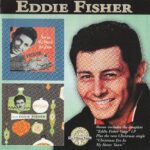
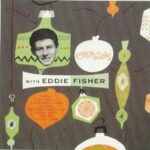
The cover of the original album is featured on the cover of the CD. The cover for I’m In The Mood For Love is also featured on the cover, along with a large picture of a smiling Eddie Fisher. The original album cover features simply drawn Christmas ornaments of varying shapes and colors on a brown background. The largest ornament, in the upper left, has a black and white picture of Eddie Fisher. Other ornaments contain the rest of the album title.
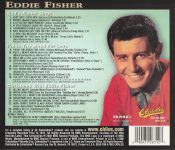
The back of the CD again shows a picture of a smiling Eddie Fisher. Most of the space on the back is dedicated to a list of each original album with numerical track listings. In addition, writer credits and time signatures are included with each song. There are 8 songs for each album (originally 10” LPs), and one bonus Christmas song for a total of 25 songs.
The CD cover comes out and opens along three fold-outs, giving a total of seven more pages of additional information. Once fully opened, the inside has five pages of the liner notes that were on the backs of all the original albums. As far as the Christmas record goes, the exact same critique from the album is included in its entirety, word for word, albeit in a different font. It gives a brief biography of Eddie Fisher’s career and some insights into the recording of this Christmas record.
Two pages, the front and the back of the last page, is a mail-in postcard for receiving a catalog from Collectables® Records.
The last page of text from the Christmas portion of the liner notes also contains information on the recording dates of all the songs included on the CD. Also, copywrite notices are given and a web address for oldies.com.
There were 8 songs on the original LP, and this CD contains them all in their original order and even includes a bonus Christmas song from 1953. Hugo Winterhalter & his Orchestra provide the lush arrangements and the backup chorus is the Hugo Winterhalter Chorus.
The song selection is a mix of traditional Christmas hymns, familiar secular Christmas songs and a few that are not so familiar.
The 1st song is Silent Night. Tolling bells keep time while Eddie Fisher sings the lyrics solemnly. After the first verse, Hugo Winterhalter’s mixed chorus joins with Eddie Fisher. For the middle instrumental break, brass instruments join the bells. The melody is primarily tolling bells with occasional brass instruments. I cannot detect a string orchestra present.
The 2nd song is White Christmas. The vocals are traditional, and the melody is carried by a light orchestra. The mixed chorus adds wonderful harmony to Eddie’s vocals.
The 3rd song is probably Eddie Fisher’s most popular Christmas song. You’re All I Want For Christmas should be a familiar Christmas song to most listeners, and that is most likely because of Eddie Fisher’s version. It was a Top Thirty hit in 1953 on the Pop charts. The song begins with a burst of strings and brass, which falls back as Eddie Fisher and the chorus begin the song in unison. This song showcases Eddie’s wonderful tenor voice beautifully. His phrasing is clear, and his rhythm glides up and down over the melody perfectly. The arrangement is achieved with a full orchestra, but the music stays light. The end is dramatic as the music stops, and Eddie Fisher and the chorus finish a cappella.
The 4th song, Christmas Day, I believe is an original Christmas song, unique to this album. I have other versions of songs titled Christmas Day, but none, although there are different ones amongst them, are like this one. The Hugo Winterhalter Chorus opens the song triumphantly, then disappears as Eddie Fisher begins the vocals. The orchestrations are light, with piano, celeste and strings carrying the melody. In the song, Eddie Fisher declares that his heart will be with his true love on Christmas Day. He requests that a place at the table be saved for him because no matter what it takes, he will be there on Christmas Day. The chorus echoes Eddie Fisher during the refrains.
The 5th song, That’s What Christmas Means To Me, is another original Christmas song unique to this album. The arrangement is mostly strings with harp and celeste. Eddie Fisher describes all the things, like seeing friends, greeting neighbors and seeing the star of Peace shine overhead that gives meaning to Christmas for him.
Here Comes Santa Claus (Right Down Santa Claus Lane) is one of the best recordings of this song, and yes, it is in my Top 500 Christmas Recordings. Eddie Fisher’s vocals are solid and sincere. The instrumental middle part borrows from Gene Autry’s version in that the reeds are matched with an accordion. There are times, during the refrains, that the music becomes scarce, and Eddie Fisher and the chorus carry the melody on their own.
The 7th song, Jingle Bells, is delivered as well as all the others with light orchestrations and great accompaniment by the mixed chorus. Reeds matched with an accordion open the song, and the vocals are primarily sung by the chorus. It isn’t until the middle of the song that they drop out and Eddie Fisher sings the vocals all by himself. The vocals are shared equally till the end of the song which ends triumphantly while the music trots out.
The last song on the original album is another song on this album that’s in my Top 500 Christmas Recordings. That makes three off this album. The song, O Come, All Ye Faithful (Adeste Fideles), is voiced more reverently than the others, but then again, the lyrics almost command it. The arrangement features full orchestration with tolling bells and light celeste. This is an endearing version of a Christmas Classic.
But wait, it’s not over yet. This CD contains a bonus Christmas song from 1953, Christmas Eve In My Hometown. I think most people, if they are familiar with this song, probably know it from Bobby Vinton from his Christmas album in 1973. I have many other versions, but Eddie Fisher does a terrific job on this one. Hugo Winterhalter once again is in command of the orchestra, as is his chorus to assist. The lyrics tell of a man yearning to be home for Christmas as the memories of Christmas Eve are pervasive. He envisions all the grandeur and sights and sounds of Christmas Eve In His Hometown.
This is a terrific Christmas album recorded near the beginning of the Classic Christmas Music Era. Hugo Winterhalter was an established orchestra leader, and he knew exactly how to keep the arrangements light and let Eddie Fisher’s voice shine through the melodies.
If you seek Classic Christmas albums and don’t already have this in your collection, you need to consider adding it. This will appeal more to people born before 1970, but it should be welcomed by anyone who enjoys Christmas music. Few singers today can match the strength and tone of Eddie Fisher’s voice. Yes, I know there are a lot of names you could point out, but the style and inflection of Eddie’s voice was also due to the way Pop music was performed in 1952.
I give this CD :
*****