Pop Vocals

January 8, 2023

# 98

VA - Classic Christmas
2004
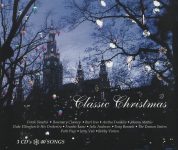
Front
Back

© 2004 Sony Music Entertainment Inc. / This Compilation (P) 2004 Sony Music Entertainment Inc. / Manufactured by Sony Music Custom Marketing Corp. / “Sony Music” is a trademark of Sony Corporation.
A3K 72893

Genre : Pop Vocals

If you were allowed to own only one Christmas CD or box set, this CD box set from Sony Music Entertainment Inc. would have to be one to consider.  Once again, Sony Music has done a great job of putting together a 3-disc set of familiar Christmas favorites.  There are 40 songs spread out over 3 CDs and the whole set takes over 1 hour and 45 minutes to complete.  That’s a good start to any Christmas collection.

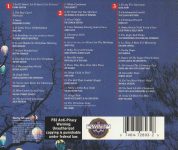
First, let’s get to the artwork.  As per Sony releases, there is room for improvement.  The cover is festive.  It shows a large cathedral’s silhouette against the dusk of a cloudy evening.  The nearby tree branches are decorated with Christmas ornaments.  The CD title appears a little below the center and some of the artists featured on the CD are listed in sentence form below the title.

The back of the CD has a continuation of the night sky.  Superimposed over the image are three separate numerical track listings, one for each CD, featuring performing artists.  Below are typical copywrite notices.

The fun stops there, though.  All three CDs come in a box that has two distinct sections that open along hinges built into the case.  I’m sure you are familiar with this type of CD case.  There is enough room to add one more CD, and a small booklet.  But there is no small booklet.  Sony missed a great opportunity to include a multiple-page booklet giving more information about the songs.  Years of recording, writer credits and any other information is always appreciated.

Of course, the fun doesn’t really stop with the lack of liner notes, the fun is just beginning.  Like I said earlier, this could possibly be the only Christmas compilation CD you would ever need.  Most of the songs are familiar Christmas hymns and carols or secular Christmas songs from the 20th century.  Most of the artists are familiar as well.  There are a few songs most listeners will not be familiar with and there are some artists that are not known solely for their Christmas music.  For me, that just makes for a more well-rounded collection.  Too many Christmas compilation collections that feature the same songs over and over already exist.

Frank Sinatra, (Let It Snow! Let It Snow! Let It Snow!, 1950), Johnny Mathis, (Give Me Your Love For Christmas, 1969), Burl Ives, (O Little Town Of Bethlehem, 1968), Tony Bennett, (White Christmas, 1968) and Andy Williams, (Some Children See Him, 1965) are all here.  Doris Day, (Christmas Present, 1964), Rosemary Clooney, (Snow, 1954), Aretha Franklin, (Winter Wonderland, 1964) and Patti Page, (Christmas Bells, 1965) are all here as well.  I noticed there was no Bing Crosby or Perry Como.  That’s because most of the artists, if not all, were on Columbia Records.  Bing Crosby was on Decca and Perry Como was on RCA Victor.

Vocal groups such as The Lennon Sisters, (Silent Night, 1960), The Brothers Four, (Mary’s Little Boy Child, 1966), and The New Christy Minstrels, (O Bambino (One Cold And Blessed Winter) 1966), all contribute one song.  The Hi-Lo’s sing a haunting version of The Star Carol a cappella, from 1959.  It must be heard to be appreciated.

Christmas stalwarts the Percy Faith Chorus, (We Need A Little Christmas, 1966), and the Ray Conniff Singers, (Here Comes Santa Claus, 1959), are here to enjoy also.

All the songs date from the late 1940s to the early 1970s, so that means all the songs are from the Classic Christmas Music Era.  Frankie Laine sings You’re All I Want For Christmas from 1948.  The Modernaires provide their tight harmonies along with a Big Band arrangement of The Jingle Bell Polka from 1947.  Dinah Shore and Buddy Clark sing their # 3 duet hit, Baby, It’s Cold Outside, from 1949.

Orchestras, symphonic or otherwise, are represented by Duke Ellington, (Jingle Bells, 1962), Andre Kostelanetz, (Sleigh Ride, 1963), Lester Lanin (Dance Of The Sugar-Plum Fairies, 1959) and Les Brown And His Band Of Renown, (We Wish You The Merriest, 1961).

The two songs from the 1970s are Julie Andrews, The Secret Of Christmas, from 1973 and Vikki Carr, What Child Is This?, from 1972.

There are two songs I have been having trouble getting years for.  Diahann Carroll sings Lo, How A Rose E’er Blooming.  This could be anywhere from 1965 to the early 1970s.  I’m inclined to believe it’s from 1965.  The first time it shows up on a Christmas album is a Christmas compilation LP, Great Songs Of Christmas, that was distributed through Goodyear in the 1960s.  Many times, songs appear on these types of commissioned LPs and nowhere else.  But I need label confirmation before I can accurately say that it’s from 1965.

The other song, The Christmas Song (Chestnuts Roasting On An Open Fire), by Mel Torme, is not as easy to track down.  Mel Torme recorded this Christmas classic that he helped write numerous times.

Some other artists worth mentioning include Jimmy Boyd (I Saw Mommy Kissing Santa Claus, 1952), Bobby Vinton, (The Bell That Couldn’t Jingle, 1964), Gene Autry, (Frosty The Snowman, 1950) and Roy Orbison, (Pretty Paper, 1963).

17 of the 40 songs appear in my Top 500 Classic Christmas Recordings.  Two of those that I have yet to mention include Arthur Godfrey With The Chordettes And The Cherry Sisters singing A Marshmallow World from 1950, and Mitch Miller And The Gang singing Must Be Santa from 1960.

A few of my personal favorites include Louis Prima & Kelly Smith with their hip, jive swinging Shake Hands With Santa Claus from 1951.  Jim Nabors, (Three Wise Men, Wise Men Three) and Jerry Vale, ((There’s No Place Like) Home For The Holidays) are both from 1967.

As you can see, many different genres of music are here as well.  Christmas music comes in all kinds of flavors, and I look at it like this; we know it’s Christmas music, but what style is it in, and who was the audience the song was targeted to.  In addition to Pop Vocals, there are Symphonic, Orchestral and Big Band Christmas songs.  Irish Folk Christmas is represented by The Clancy Brothers with Christmas In Carrick from 1969.  Gospel singer Mahalia Jackson sings Do You Hear What I Hear? From 1968.

Most all of these songs come from Christmas albums released by the individual artists, and I have most of those in my collection.  Look for reviews of those Christmas albums elsewhere in this blog, or in this blog’s future.

One of the greatest things about this Sony Christmas compilation box is that no single artist has more than one song, and the same song title is not repeated throughout all 3 CDs.  That makes for 40 individual artists singing 40 different, terrific Christmas songs.

Because this CD does not contain artists from Decca, RCA Victor or Mercury, etc., there is room in your collection for more great Christmas compilations.  The Readers Digest box sets are also terrific Christmas compilation CDs to own.

The thing to take away from this review is this : Sony Music puts together great Christmas music collections, some are a single CD, and others like this one, are 3 CD sets.  Look for the Sony Music collections when you look for Classic Christmas music.

I give this CD :

****
January 6, 2023

# 94

June Christy
This Time Of Year
2005

(Originally released 1961 on Capitol Records)

Back

(P)2005 EMI Music Special Markets ©2005 Collectors’ Choice Music.
Manufactured by EMI Music Special Markets.

Genre : Pop Vocals

Just as I mentioned a few reviews ago that John Gary was the best male Pop Standards vocalist you’ve never heard of, I can honestly say that June Christy is the best female Pop singer you’ve never heard of.  To be more accurate, June Christy was really a Jazz vocalist, but she did record Standards in addition to Jazz interpretations.

June Christy was born Shirley Luster in 1925 in Springfield, Illinois.  She grew up in the suburbs of central Illinois.  She began singing professionally at the age of thirteen and sang all throughout high school.  Most of her singing occurred as the girl singer of local territory bands.  It was during this time that she changed her name to Sharon Leslie.

After changing her name once again, this time to June Christy, she eventually replaced Anita O’Day in Stan Kenton’s Big Band in 1945.  It is with Stan Kenton that June Christy really started getting attention.  She has a smokey, suave, light vibrato to her voice that is perfectly suited to Jazz standards.

While still with Stan Kenton’s band, June Christy started releasing records under her own name, starting in 1947.  After many singles throughout the late 40s, her first album was released in 1954 and simply titled Something Cool.  It was me acquiring that album on CD early in my collecting years when I discovered June Christy and I’ve been a fan of hers ever since.

June Christy released numerous albums every year from the late 1950s through the mid-1960s.  In 1965, she started feeling the strain on her marriage and cut back on her touring schedule.  By the late 1960s, she started releasing fewer albums, and only released one every few years afterwards.  She died of kidney failure in 1990, at the age of 64.

This is June Christy’s only Christmas album and it was recorded at the peak of her career in 1961.  The music is provided by Pete Rugolo & his Orchestra.  June Christy started working with Pete Rugolo in 1947 with her first solo recordings and he was her orchestra director for most of her career.

Collectors’ Choice Music has done another terrific job of releasing an old Christmas album on CD.  Collectors’ Choice Music is a label that specializes in releasing older albums and great compilation CDs of all genres of music.  This CD reissue is produced in partnership with EMI Music Special Markets and Collectors’ Choice Music.

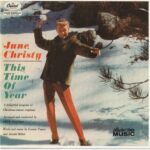
The cover of the CD is an exact copy of the original album cover.  Nothing is moved and nothing is missing, and the only addition is the Collectors’ Choice Music logo in the bottom right corner.  The cover shows a young-looking June Christy getting ready to throw a snowball right at the camera.  She is standing in a snowy field at the edge of a white pine tree.  Her name appears to the left in red letters, and the album title appears below in green letters.  A small description of the album, the conductor and the writers are listed.

The back of the CD is a near copy of the back of the original album.  Both are the same except the back of the CD is missing the endorsement found on the back of the album.  In its place is a numerical track listing.  The photo on the back cover shows June Christy shaking the snow off the branches of the white pine tree she is standing next to.  Where the track listing was on the back of the album, on the back of the CD, there are typical copywrite notices and label logos.

The CD cover comes out and opens along a single fold-out.  Both sides of the inside contain a critique and endorsement of this CD reissue.

The back of the front cover shows a smaller image of the back of the original album, including the original endorsement and placing of the track listing.  Although it is an exact replica of the back of the original album, the version on the CD is in black and white, whereas on the original back of the album, it was in color.  It is an exact copy, but still too small to read the endorsement without a magnifying glass.  To the right of the album image is a numerical track listing including publishing credits.  Below the image are more detailed copywrite and production notices, some from the original album and some for the CD reissue.

Overall, the artwork is very good.  There is nothing from the original album that we are missing.  The two-page review inside the CD cover is a nice bonus as well.

Collectors’ Choice Music did not include any bonus tracks with this reissue and that’s okay with me.  Bonus tracks can be a nice plus, but when the original album, with the original artwork and original title are reissued, I prefer to keep it the way it was when originally released.

As with everything else, the songs are kept in their original order too.  There is something unique about this album, something that you rarely ever see in a Christmas album, and that is all 10 songs are original songs written by the song writing team and husband and wife duo, Connie Pearce and Arnold Miller.  Off the top of my head, I cannot recall a Christmas album or CD in my huge collection that contains only all original Christmas songs.

Another thing should be said about this album, and that is not ALL the songs are Christmas songs.  There are two ‘Winter’ songs and one really neat New Year’s Eve song.

Usually, a part of my review includes my observations of the current artists’ version of a Christmas song and how it compares to traditional versions of the same song.  That is not possible to do with this album because there is nothing to compare it to.  These are all unique Christmas songs you will not find anywhere else except maybe one or two on a Christmas compilation..

The CD begins with a dour Christmas song, Christmas Heart.  June Christy reveals her true self with this song.  She was known for her smokey, dour vocal style.  Even though the arrangement features lush strings and a full orchestra, June Christy’s vocals put a little Jazz flavor in all the songs.  I have this Christmas CD cataloged as Pop Vocals, but it could be / should be cataloged as Lounge.  (The presence of the lush strings makes it hard to define this as Lounge).  Nonetheless, it is an endearing song of love.  The arrangement is very lush with a large string orchestra, harp and celeste.

In fact, June Christy was instrumental in making the music style known as ‘cool’, very popular.  Smokey lounges, cocktail waitresses trying to stay hidden and a girl singer up on a dimly lit stage were the epitome characteristics of Lounge music.

The 2nd song, Ring A Merry Bell, features more of a Jazz arrangement.  Gone are the strings and in their place are brass instruments.  Another smokey song that has June Christy wishing her friends and family a Merry Christmas without her, for she is “far from home”.

The 3rd song, Hang Them On The Tree, starts with the brass section, then as they fade away, piano and acoustic guitar continue the melody.  After the first set of verses, the whole group comes together to complete the song.  This is a somewhat strange Christmas song.  The lyrics describe a woman who reflects on the past year at all the hardships, loves lost, feelings hurt, etc. and turns them into Christmas ornaments as a way to repurpose her feelings. (?)  Yea, that’s kind of the way I heard it.  The music is fine, but the song could fool you if you don’t pay too close attention to the lyrics; it’s a kind of bizarre Christmas song.  I guess it’s the story of a woman making the best of a sad situation at Christmas time.  These are the kind of torch songs June Christy was known for.

The Little Star, the 4th song, restores our faith in the season.  It’s a cute Christmas song that personifies a little star who wishes for something bigger.  It’s the classic Rudolph story but told in the persona of a star.  The arrangement is again lush.  Gone is the brass Jazz orchestra, and Pete Rugolo commands a fine orchestra.

The 5th song, The Merriest, is June Christy’s most common Christmas song.  If you have a Christmas compilation CD with one June Christy song on it, I guarantee, it’s this song.  It’s a swinging Jazz orchestral arrangement.  It is June Christy’s way of wishing all the naysayers, downers and mopes a Merry Christmas.  It’s a great original Christmas song and it appears in my Top 500 Classic Christmas Recordings.

The 6th song is the album title, This Time Of Year.  It features a traditional arrangement of strings, flutes and reed instruments providing a lush background for June Christy as she again croons her sorrows as others around her enjoy a much better Christmas.  She seems sad in her situation, but freely admits that she’s responsible for it at the same time.  Another dour, sad Christmas song…if you listen to the lyrics.

The 7th song, Seven Shades Of Snow, is more of a ‘Winter’ song, than a Christmas song.  The music begins with the string section that allows an acoustic guitar to finish the introduction as June Christy begins her vocals.  The rest of the arrangement features lush strings, simple reed instruments and a terrific celeste that accents the ends of the verses.  In the lyrics, June Christy uses colors to describe her moods at Christmas time and how they are reflected in the new snow.  As she reckons with each one, together, the Seven Shades Of Snow make for warm feelings in her heart.  She never mentions the word ‘Christmas’ so this song could also be just another sad heart song with a happy ending.

Sorry To See You Go, the 8th song, would at first, after all the heart reckoning June Christy has given us so far with this album, cause you to presume she is telling her boyfriend that he can go, that she is better off without him.  But, apply that sentiment to the year, and it is a neat New Year’s Eve song about the end of the old year and the anticipation of the new one that’s about to begin.  After a light Jazz piano and combo introduction, the band swings the rest of the melody.  After the earlier song The Merriest, this is the second-best song on here.

The 9th song is The Magic Gift.  While the arrangement remains somber, June Christy describes her feelings towards the gifts her lover gave her, presumably for Christmas, although she never mentions that word.  It could be any kind of gift.  In fact, at the end, she says the true gift she received, if you add up all the individual gifts, was love.

The original album, and the CD, ends with Winter’s Got Spring Up Its Sleeve.  Again, not a Christmas song, but I never mind a ‘Winter’ song now and then.  One time, I mixed all the ‘Winter’ songs that I have in my entire music collection into my regular playlist of Pop Vocals, and they sounded out of place because the lyrics did not match the current outdoor surroundings, especially in the summer.  The best time to listen to ‘Winter’ songs is during the Christmas season.

I like having this CD in my Christmas music collection.  I am a big June Christy fan.  She posses a unique voice and a vocal styling that was original when she first started and helped many others succeed afterwards.  But…this is an unusual Christmas album.  If you are looking for Rudolph, Winter Wonderland and having a White Christmas, you better look elsewhere.  This CD is not that and it will only disappoint you.

This Christmas CD is not going to appeal to a lot of people.  Most of the time, listeners want to be somewhat familiar with the songs they are hearing, at least the titles.  Other times, Christmas music is used more for background music to entertain a diverse group of people, and this will not make most spirits bright.  Again, mixed in with a large playlist of all kinds of Christmas music, this would pass.  But if you pass on this CD, please at least include The Merriest in your Christmas playlist.

If you appreciate all kinds of Christmas music, especially Christmas music from the Classic Era, you would probably like this.  Most of the arrangements are Jazz based and without a doubt, June Christy’s vocals are.  This Christmas CD is one of those Christmas albums that should be described as Lounge music and should be treated as such.  If you are having a retro, ‘cool’ Christmas party, you better have this on hand.  This CD, along with some of the many ‘Cocktail’ themed Christmas compilation CDs, makes for a great playlist if you can put a 100 or so together.  (By the way, 20 Christmas songs take only one hour on average, to play.  If you are having a six-hour party, you should have at least 130 songs ready).

I give this CD :

****

December 29, 2022

# 93

Dean Martin
A Winter Romance
2007

(Originally released 1959 on Capitol Records)

Back

EMI Gold is a Capitol Records Label
(P) 1998 The copywrite in this compilation is owned by EMI Records Ltd. © 2007 EMI Records Ltd. This label copy information is the subject of copywrite protection. © 2007 EMI Records Ltd.

# 27 – 1965 – Billboard Christmas

Genre : Pop Vocals

It’s Dean Martin!  Finally, the first review of a Dean Martin Christmas album.  Some things should be said right away about this CD reissue of Dean Martin’s Christmas album from 1959, A Winter Romance.  First off, this is a reissue of Dean’s 1959 Christmas album, and it contains 6 bonus tracks.  The original songs are all here but in a different order than on the original album.

Plus, this album has been reissued on LP many times since 1959.  The first reissue occurred in 1961 and had a different cover.  It was reissued again in 1962, again with a different cover from either earlier issue, and with two songs missing.  Then, in 1965, it was reissued again, under the title, Holiday Cheer, again with a new cover.  Also with the 1965 reissue, only one of the missing tracks was restored, and ironically enough, the remaining missing song from that 1965 reissue was the original album title, A Winter Romance.  It was this reissue that first charted on the Billboard Christmas charts that year.  I find it hard to believe the original album did not chart in 1959.

The LP was first issued on CD in 1989.  That release restored the original album cover, and all original 12 tracks, plus one bonus track.  The album has been reissued many times on CD as well.  Depending on when you bought it, will determine what cover you get and how many bonus tracks you get.

I have mixed feelings about my copy.  Mine is a European release, dating to 2007, and comes with 6 bonus tracks, the most of any of the reissues.  But, the cover is not original.  Collectors’ Choice Music released a CD reissue in the US in 2005 with the original cover, the original tracks and 4 bonus tracks.  Less than what I have now, but I don’t have the original cover.  I always try to get the CD reissue that has the original cover, unless it’s a CD-R.  I try to avoid those.  But the 4 bonus tracks on the Collectors’ Choice Music release in 2005 are NOT Christmas songs.  Unfortunately, out of the 6 bonus tracks on this CD, only one is a Christmas song.  None of the bonus tracks on this CD reissue are the same as any of the bonus tracks on the Collectors’ Choice Music release from 2005.  And, after looking over all the CD reissues throughout the years, the CD here has the most songs, even though only one bonus track is a Christmas song.  In hindsight, I’d rather have a CD reissue with the original cover, even if it has only one bonus track, which happens to be a Christmas song.  Song for song, I would still have just as many Christmas songs, and I would have the original cover.  Capitol Records released a CD just as I described starting in 1989.  If you’re like me with your Christmas music, that is the one you want to look for.

Dean Martin should be well known to everyone, but a little refresher is always helpful.  Born in Steubenville, Ohio in 1917, Dean Martin was the first-generation Italian American on his father’s side of the family.  His mother was a first-generation Italian American as well.  By all accounts, Dean Martin grew up in a middle-class household.

While bouncing around in odd jobs as a teenager, Dean Martin would also sing in local clubs.  He would leave one band for another, and in three years, would leave for yet another.  By the mid 1940’s, Dean Martin was working as a band singer in New York City.

It was in 1946 that he met the comedian Jerry Lewis, and oddly enough, they became a very successful comedy team.  Jerry Lewis would do his regular easily excited juvenile bit while Dean would sing.  The constant interruptions between the two proved very successful.  They made many movies together and appeared in New York nightclubs to sold out audiences.

The team broke up in 1956, and each went their separate ways.  Dean Martin continued to perform in nightclubs, appear in movies, and release albums.  His association with Frank Sinatra led to great opportunities.  By the late 1950s, Frank, Dean, Sammy Davis, Jr., Peter Lawford and Joey Bishop were inseparable.  Affectionately known as the “Rat Pack”, they were known to be a party just amongst themselves.  Their Hollywood / Las Vegas antics are legendary.

Dean Martin’s star continued to rise.  By the mid-1960s, he had a film franchise appearing as Matt Helm in a number of movies.  He had his own highly successful variety show on NBC until 1974.  After that, Dean Martin did about 4 celebrity roasts a year for NBC TV for a number of years.

Dean Martin had built a reputation as an all-around fun guy.  Sassy, quick witted, and appearing intoxicated most of the time, became his persona.  In truth, Dean was a dedicated family man and enjoyed going home to his wife and children every night.

Having been a lifelong smoker, Dean Martin was diagnosed with lung cancer in 1993 and passed away on Christmas Day, 1995.

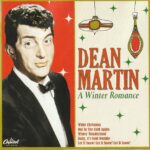
On to the review.  Although the album title remained the same, the cover artwork is completely different.  The CD reissue shows a picture of Dean Martin dressed in a tuxedo on the left-hand side.  His image is superimposed against a red background.  The right side of the front cover has his name in large red letters and the CD title, “A Winter Romance”, in smaller green letters below his name.  Hand drawn Christmas ornaments decorate the area.  A few songs included on the CD are listed near the bottom.  All the graphics on the right-hand side are superimposed against a white background.

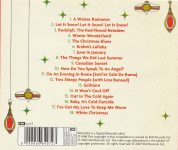
The back of the CD is mostly a numerical track listing.  The track numbers are in green, and the song titles are in red.  Some of the same hand drawn Christmas ornaments from the front cover are duplicated on the back.  All is featured against a white background.

The CD cover comes out and opens as a stapled, six-page booklet.  The first and third pages display Dean’s name in bold letters against green and red backgrounds, respectively.  The second and fourth pages feature a numerical track listing that includes writer and publishing credits.  More hand drawn Christmas ornaments decorate all the pages.  The fifth page is just red and gold bold stripes with little white sparkles.  The sixth page shows a smiling Dean Martin in a white shirt, gold tie and a festive red sweater vest.  There are microphone stands behind and the setting looks to be in a recording studio.

The back of the CD cover is gold with white sparkles.  No wording exists except for typical copywrite notices at the bottom.

All the songs from the original album are present, but the songs are in a different track order than what’s found on the original album.  Half of the songs on the original album, aren’t really Christmas songs, they are more ‘Winter’ songs.  Even a lot of the Christmas songs are more Winter songs than true Christmas songs, although they are familiar Christmas songs.

Out of the six bonus tracks, only The Christmas Blues, released as a single in 1953, is a Christmas song.  (For this review, I will not mention anything about the quality of the non-Christmas bonus tracks other than to say that even though they are not Christmas songs, they are great Dean Martin songs).

All the songs’ arrangements on the original album were conducted by Gus Levene as well as the chorus.  Three of the bonus tracks were conducted by Dick Stabile, one is conducted by Walter Scharf, one conducted by Frank Sinatra, and one conducted by Gus Levene, the orchestra leader of the original album.  Three of the bonus tracks precede this album in 1959.

Out of the six true Christmas songs from the original album, all are familiar secular Christmas songs from the 20th century.  All are on the romantic side of Christmas except Rudolph, The Red-Nosed Reindeer.  Songs such as Let It Snow! Let It Snow! Let It Snow!, Winter Wonderland, Baby, It’s Cold Outside, I’ve Got My Love To Keep Me Warm and White Christmas remind us that Christmas is always more fun when two people are involved.

The ‘Winter’ songs are great Dean Martin songs.  The CD title, A Winter Romance, and June In January, The Things We Did Last Summer, Canadian Sunset, It Won’t Cool Off and Out In The Cold Again were all recorded in 1959 along with all the other Christmas songs.

The one bonus track that is a Christmas song is The Christmas Blues.  It features Dean pleading the lyrics of a bluesy Christmas song.  The arrangement combines Jazz elements in the brass section as the rest of the arrangement consists of lush strings.  This song was recorded in 1953.

Another bonus track, Brahms’ Lullaby, shows up on many other Christmas compilations.  This solemn track from 1959 features a lush string section conducted by Frank Sinatra, who had already recorded and released the song in 1945.

The great news with this CD is that all 6 ‘true’ Christmas songs are terrific Christmas songs, and all appear in my Top 500 Christmas Recordings.  The orchestrations are traditional; lush string arrangements paired with seasonal brass and reed instruments.  All are very familiar Christmas songs still heard every year.  Dean Martin was one of the best Christmas crooners of all time.

The not-so-great news with this CD, and the original album, is that half the songs are not Christmas songs.  This was the first Christmas effort for Dean Martin.  As great as the Christmas songs are, this album did not chart until 1965 under the title Holiday Cheer.

So, out of the 18 songs, only seven are Christmas songs.  That means 11 are not.  That’s a high percentage and makes it difficult to say this is a great Christmas CD.  Dean Martin is a great singer of Christmas songs and released another Christmas album in 1966 and there was only one out of 10 that wasn’t a Christmas song on that one.

Altogether, Dean Martin recorded around 16 Christmas songs.  Almost half are on this CD.  It would probably take a couple of CDs to get all of Dean Martin’s Christmas output since most Christmas compilation CDs still only have 10 or 12 songs on them.  Most Dean Martin Christmas compilation CDs contain many of the ‘Winter’ songs that are featured here.

Overall, we got the first Dean Martin Christmas album with 6 bonus tracks.  That’s pretty good in itself.  The other Dean Martin compilation CD I have is titled Making Spirits Bright, and with that, yes, I now have all of Dean Martin’s Christmas output.  (Look for a review of that CD sometime in this blog’s future).

I give this CD :

***

December 25, 2022

# 84

John Gary
The John Gary Christmas Album
2000

(Originally released 1964 on RCA Victor)

Back

Courtesy of the RCA Records Label
The BMG Logo is a trademark of BMG Music. Manufactured by BMG Special Products, a unit of the BMG Entertainment.
© 2000 RESTART temps, Inc.

# 3 – 1964 – Billboard Christmas

Genre : Pop Vocals

John Gary is the greatest Pop Standards singer you’ve never heard of.  I stumbled upon him in the very early days of my CD collecting.  I have a Very Best Of CD that was probably among the first 20 CDs I ever bought.  I have been a big John Gary fan ever since.  I was impressed with his career achievements when reading his biography on Wikipedia to get ready for this review.

John Gary Strader was born in 1932 in Watertown, New York.  He started singing at the age of 5 and by the age of 12, he had received numerous awards for his singing.  At the age of 12, he toured around the southern states.  Incredible.

He was seen on local TV and heard on local radio in Louisiana.  At the height of his career, he appeared on Broadway, played Carnegie Hall, and appeared on the Tonight Show numerous times during all the hosts’ tenures.  John Gary toured the country extensively throughout the 1960s.  He also had his own TV variety show for a while. 

John Gary was considered to have the smoothest tenor voice during the 1960s.  After signing a recording contract with RCA in 1963, he went on to release almost 30 albums for RCA Victor throughout the 1960s.  After the sixties ended, so did his popularity.  He would continue to release albums throughout the 70s and 80s, but only a few in the 1970s, a couple in the 1980s and one in the 1990s before his death from cancer in 1998.

This CD is a reissue of John Gary’s Christmas album from 1964.  The title remains the same, and the songs are presented in their original order.  But any resemblance to the original album ends there.  This reissue is produced by BMG Special Products, courtesy of the RCA Records Label.

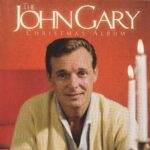
The cover for the CD shows a head and shoulders picture of John Gary in a yellow cashmere cardigan over a light blue sport shirt.  Two lit candles sit in front of him.  The CD title appears at the top of the cover in white letters.  John Gary’s name is considerably larger than the rest of the title.  All is superimposed over a festive red background.

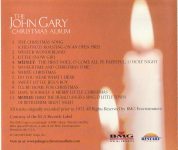
The back of the CD has a close-up picture of the candle flames from the front cover.  The title appears near the top on the left and below is a numerical track listing.  Below are copywrite notices from RCA Records, BMG Special Products and RESTART Temps, Inc.  Again, all is superimposed over a festive red background.

The back of the CD cover holds no new information.  The CD cover is only a double-sided piece of heavy paper.  The back of the CD cover is an almost exact duplication of the back of the CD but in black and white.  Some of the copywrite notices are worded differently and in a different spot, but overall, the back of the CD cover is just a black and white image of the back cover.  More detailed recording information would have been nice.  We don’t get time signatures, writer credits or publishing information.  There are quite a few Christmas songs on here that are unique to this album, and more information would have been a bonus.

The cover for the original album was much more festive and had the look many Christmas albums had in 1963.  It featured a picture of a smiling John Gary dressed in a tuxedo, holding a couple of ornately wrapped Christmas presents.  In the background is a slightly out of focus Christmas tree.  The background is light green, and the album title appears at the top and the songs are listed underneath the title.

The original album contained 11 songs.  Peter Matz & his Orchestra produce all the wonderful, lush arrangements.  Out of the 11 songs, only four are traditional Christmas hymns.  But two of those songs are medleys so we get a total of 8 familiar Christmas hymns.  Of the other songs on the CD, five are familiar secular Christmas songs from the 20th century.  There are two original Christmas songs that are unique to this album.  With all that said, there is still no mention of Rudolph, Frosty or even Santa himself.

The CD begins beautifully.  The 1st song, The Christmas Song (Chestnuts Roasting On An Open Fire), has the greatest opening I’ve ever heard.  The arrangement begins triumphantly with sleighbells, celesta and brass, then quickly the chorus declares “Merry Christmas, Happy Holiday…”.  The arrangement they sing to has nothing to do with the song itself, it’s not the same melody.  It’s an opening verse of sorts and it adds a wonderful start to the whole album.  The orchestrations and John Gary’s vocals are soft and traditional.

The 2nd song, Winter Wonderland, is soft.  The melody is accented with flutes that dance through the verses.  The string orchestra and the celesta combine to make for a beautiful song.  The chorus echoes the vocals softly on the refrains.

The 3rd song is an original Christmas song, unique to this album.  Little Snow Girl uses reeds, celesta and flutes along with soft choral voices to produce an endearing Christmas song that speaks of the love a Little Snow Girl finds in an adjacent snowman.  It is a love song just like many others were written at the time, but the subjects are not young couples, or teenagers, they are snow people.  The song has all the elements that love songs did in the early 60s, it’s just the nature of the subjects that makes it a cute song.  The song goes on to caution the Little Snow Girl not to cry when the snow stops falling and the sun comes out and begins to melt the snow man, for he will return next year.  It’s not really a Christmas song, but nonetheless, it’s a fun Winter song.

The 4th song is a medley of three traditional hymns; The First Noel / O Come All Ye Faithful / O Holy Night.  The songs are structured with their own unique arrangements making it three separate songs.  The transitions between the songs use brass instruments to finish the current song and add an introduction into the next song.  We get three distinct Christmas songs in 4:40.  The arrangements are all triumphant and the chorus joins in full voices on all the songs.

The 5th song, Wintertime And Christmas Time, is another original, unique Christmas song.  The song speaks of the sights and sounds of Winter and how it ushers in the Christmas season.  The song ties into the Three Wise Men and their journey to the manger on Christmas Eve.

White Christmas follows.  The arrangement is light, and the chorus adds soft harmonies.  There is no mention in the liner notes of the CD or the original album as to who the chorus might be.  I’m sure RCA had a large ensemble of voices they could pull together.  The song ends jubilantly as John Gary and the chorus shout a warm Christmas greeting.

The 7th song is Do You Hear What I Hear.  The opening features brass and a snare drum paired with cellos, while the arrangement stays light throughout the song.  Flutes and muted brass instruments accompany a light string orchestra to make up most of the melody.  As the song progresses, John Gary declares the vocals in reverence.

Sweet Little Jesus Boy follows as the 8th song.  It is not a commonly recorded song, yet it should be familiar to seasoned listeners.  Again, the instrumentation is light, incorporating acoustic guitar with muted trumpets.  This is one of those Christmas songs that must be sung with solemn vocals, just like Little Altar Boy.  John Gary’s vocals demonstrate the octave range he was so acclaimed to possess.

The 9th song, I’ll Be Home For Christmas, returns to lush strings and celesta.  Again, John Gary uses the softness in his voice to add passion to the lyrics.  The chorus is also light as muted trumpets assist with the refrains.

Song # 10, Have Yourself A Merry Little Christmas, begins with the refrain used as an introduction.  Again, light orchestrations of strings, celesta and brass allow John Gary’s vocals to shine.  Even with this mostly jubilant Christmas song, the arrangement is given the soft, solemn treatment.

The final song on the album is the second of two medleys.  Hark! The Herald Angels Sing / O Little Town Of Bethlehem / Silent Night begins triumphantly and again, the arrangements are completely different with each song in the medley.  Muted brass instruments usher in the second song, while tolling bells and harp introduce the final song.  More time is given to Silent Night than the other two.  This allows the CD to close with a very solemn finish.

If there was one word to describe John Gary’s Christmas album, it would be solemn.  There are very few Christmas albums that are consistently this soft and eloquent.  Peter Matz has arranged all the songs with light orchestrations as opposed to large symphonic stylings.

John Gary does a superb job on all the songs.  His voice is soft and solemn.  He treats every song with reverence and humbleness.  The chorus provides the perfect accompaniment to his vocals.  John Gary treats every song like it’s the last song he’ll ever sing.  His passion for the lyrics is transcended in every song.

As I said earlier, John Gary may not be well known to a lot of people.  He didn’t chart any Top Forty hits, and his career took place during the 1960s when Rock music dominated record sales.  His singles performed better on the Adult Contemporary charts than the Pop charts.  Yet he had one of the best voices in the Pop Standards market.  And the same can be said for his 1964 Christmas album.  This album did not go to # 3 on Billboard’s Christmas charts because it was a bad Christmas album.  On the contrary, it is one of the best Christmas albums released in all of the 1960s.

If you enjoy Christmas albums from the Classic Christmas Music Era and you like adding to them every year, then you should include this in your collection.  John Gary’s Christmas album from 1964 is every bit as good as any of the more popular Christmas albums from Frank Sinatra, Johnny Mathis, Andy Williams or Perry Como.  Most of the songs are familiar Christmas tunes and the two originals are great, unique Christmas songs.

I give this CD :

****

December 23, 2022

# 81

Kohl's Cares For Kids
Songs Of The Season
2000

Back

This compilation (P)2000 EMI-Capitol Music Special Markets ©2000 Kohl’s Department Stores. Product of EMI-Capitol Music Special Markets.

Genre : Pop Vocals

This Christmas compilation CD is the first in the Kohl’s Cares for Kids® series of CDs Kohl’s Department Stores made available for purchase in their stores during the Christmas season.  This is a great Christmas compilation CD.  It’s not difficult to obtain this CD, but you would need to get it in an on-line marketplace.  I shop Kohl’s often so when these first started coming out in 2000, I looked for them every year afterwards.  They used to sit next to the cash register, and you could pick them up for $5.00 as you were checking out.  I don’t know if they sold out quickly or what, but years later into the series, I wasn’t seeing them in the stores. It has taken me considerable effort to track down the ones I was missing.  I’ve done a lot of research into the series and think I have them all.  2015 is the last year I have, and I don’t think they released any after 2015.  If you have any further information, I would surely appreciate any help in finding out if I am missing any or if I have them all.  You can leave your comments below.

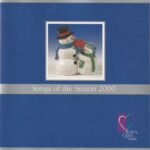
The CD artwork is nothing spectacular, but it is festive, nonetheless.  The CD cover has a small picture of a table-top decoration of two snowmen standing facing each other holding a red heart.  The picture is placed inside a white and silver border and that itself is superimposed against a cobalt blue background.  The CD title runs inside a silver bar that runs across the middle of the cover.  The silver bar is meant to resemble a silver ribbon surrounding the CD.  The Kohl’s Cares for Kids® logo sits in the bottom right corner.

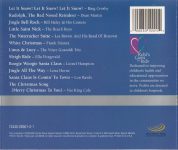
The back of the CD features a track listing with performing artist credits.  The same silver bar runs across the back of the CD but contains no words or graphics.  Again, the Kohl’s Cares for Kids® logo sits to the right side, and it has a small mission statement included.  All is presented with the same cobalt blue background.  Typical copywrite notices appear at the bottom.

The CD cover comes out and opens along a single fold-out.  The inside of the cover features only a track listing of the songs on this CD.  There are no other graphics or messages, just the song titles.  In addition to performing artist credits, writer credits are given, and some have publishing credits as well.

The back of the CD cover shows a close-up picture of our snowman couple from the front but in a reverse image.  The same silver bar runs across the back of the CD cover, which is also cobalt blue.  At the top is a personal thank you from Kohl’s Cares for Kids®.  The message reads, “Thank you for helping Kohl’s improve health and educational opportunities for children in our communities. Profits from your purchase of this holiday CD, part of the Kohl’s Cares for Kids® holiday collection, will be donated to children’s hospitals.  We at Kohl’s want to wish you and yours the happiest of holiday seasons”.

This was sort of a surprise CD for me.  I expected the same overused, familiar Christmas songs that show up on a lot of generic Christmas compilation CDs.  But I was pleasantly surprised to see that there are many songs on here that don’t.  There are only 12 songs included, and that is typical, but the variety of the artists makes up for it.  All the songs are familiar Christmas songs, but not necessarily by the artists that made them popular.

All the songs, except for The Nutcracker Suite by Les Brown And His Band Of Renown, are 20th century, secular Christmas songs.  None even come close to an old Christmas hymn.  Not even Silent Night, the most recorded Christmas song, is included.  That makes for a festive, fun-without-the-guilt, Christmas CD.  Six of the 12 songs are in my Top 500 Classic Christmas Recordings.

The CD begins with Let It Snow! Let It Snow! Let It Snow! by Bing Crosby, recorded for his 1962 Christmas album, I Wish You A Merry Christmas.  Bing’s 1962 Christmas album is one of my favorite Bing Crosby Christmas albums.  His first Christmas album from 1941, and reissued in 1945, and again in 1955 with the iconic “Bing in a Santa hat” cover, is probably the best-selling Christmas album of all time, but I still like the one from 1962 better.  The arrangement on Let It Snow! Let It Snow! Let It Snow! is light and the vocals are traditional.  Bing’s voice is still in great shape in 1962.

The 2nd song, Rudolph, The Red Nosed Reindeer, comes from Dean Martin’s 1959 Christmas album, A Winter Romance.  Gus Levene conducts the orchestra and chorus that provides light instrumentation and light harmonies.  The celesta is paired with sleigh bells and used to great effect while Dean gives the song his typical lounge cantor.

The 3rd song is Jingle Bell Rock, presented by Bill Haley And His Comets.  Recorded in 1958, it was released just one year after Bobby Helms had a hit with the original in 1957.  Bill Haley records a straightforward arrangement of this Christmas rocker that sounds awfully close to the original.

The Beach Boys deliver their classic from 1963, Little Saint Nick.  This Southern California Surf Christmas song should be very well known to most listeners.  In my opinion, it was one of the first popular, modern era Christmas songs that ventured in a different direction than traditional Christmas songs.  The Beach Boys provide their familiar five-part harmonies in a festive manner as they sing of the virtues of Santa Claus with a West Coast vernacular.

The 5th song is one of two instrumental Christmas songs on this CD.  The Nutcracker Suite was recorded by Woody Herman And His Band Of Renown in 1957.  It is a swinging arrangement of the Tchaikovsky classic.  The Nutcracker Suite combines 8 of the passages from the complete Nutcracker ballet.  Tchaikovsky had originally put the suite together after the score had been composed, but before the ballet premiered.  As the movements change, so do the arrangements.  Straight Big Band Swing arrangements glide into softer melodies and even Afro Cuban influences are presented before everything returns to the same Swing arrangement found at the beginning to finish the song off.  It is a rather long Christmas song as it clocks in at over 6 ½ minutes.

The 6th song is the seasonal classic White Christmas, sung by Frank Sinatra.  This version comes from a single Frank Sinatra recorded in 1954 for Capitol Records.  Nelson Riddle conducts the lush orchestra.  He also conducts the soft chorus that provides wonderful harmonies during the choruses.

The other instrumental Christmas song on here is the proverbial Linus & Lucy, from A Charlie Brown Christmas, recorded in 1964.  Everyone knows the song, but many do not know the name.  This is the song that is played during the famous dance scene.  An interesting, little-known tidbit about the soundtrack Vince Guaraldi & His Trio recorded for Charlie Brown’s first TV Special is that the music was recorded before the cartoon was drawn.  Charles Schultz took his inspiration from the music.  Usually, it is the other way around.  Regardless, this has been a Christmas Classic since 1964.

To me, Classic Christmas songs from TV specials from the 1960s are some of my favorite Christmas songs because the whole boomer generation grew up on them.  A Charlie Brown Christmas, Rudolph, The Red-Nosed Reindeer, Santa Claus Is Comin’ To Town and Frosty The Snowman are all classic TV Specials and contain great familiar Christmas songs.  (Look for reviews of all those Christmas TV Soundtracks in this blog’s future.)

Okay, back to this review.  With the help of Frank De Vol & his Orchestra, Ella Fitzgerald delivers Sleigh Ride from her 1960 Christmas album.  The arrangement incorporates Big Band instrumentation to produce a swinging arrangement of this familiar Christmas standard.  Ella provides a great jazz influenced vocal as she glides effortlessly through the lyrics.

The 9th song, Boogie Woogie Santa Claus, is another rousting, swinging, R&B Christmas song.  Lionel Hampton & his Orchestra recorded this in 1950.  It was first recorded by Mabel Scott in 1948.  Sonny Parker delivers hip lingo influenced lyrics.  Lionel Hampton’s Big Band featured a large ensemble of traditional Big Band musicians and his technique on the vibraphone is displayed well throughout the song.

The 10th song, Jingle All The Way, comes from Lena Horne’s 1966 Christmas album.  It is a swinging version of Jingle Bells.  The arrangement that Jack Parnell & his Orchestra provides is unique in that the arrangement is slow, then fast, then slow, then fast, then slow again as the song fades away.  Lena Horne syncopates her vocals in a jazzy manner.  Lena Horne would take familiar Pop Standards and give it her own signature sound.  That is accomplished very well here.

The 11th song, Santa Claus Is Comin’ To Town, has Lou Rawls delivering his trademark swinging Jazz vocal treatments as well.  H. B. Barnum & his Orchestra provide the Swing in this Christmas standard from Lou Rawls’ 1967 Christmas album.  It is Lou Rawls’ vocal styling that makes this song different than any other recorded version.  He has a way of swinging the lyrics by using hip slang improvisations like no one else does.  Towards the end, Lou Rawls breaks into an a cappella soulful finish.

The final song on this terrific compilation CD is fittingly, The Christmas Song (Merry Christmas To You) by the man who made it famous, Nat King Cole.  Nat King Cole recorded three different versions of this song.  The first was with his Trio in 1946.  The second was in 1953 with Nelson Riddle & his Orchestra.  This version comes from his 1963 Christmas album, which was really a reissue of his 1960 Christmas album, but with two songs replaced with two new ones.  The Christmas Song (Merry Christmas To You) was one of those songs.  Ralph Carmichael directs the orchestra in the lush arrangement.  This is the Nat King Cole version most people will be familiar with.  It is also the Classic recording of this Christmas standard written by Mel Torme and Robert Wells.

I like this Christmas compilation CD because it contains familiar songs but not necessarily using traditional arrangements.  And it contains at least six songs that are in my Top 500 Classic Christmas Recordings.  It has a lot to offer from a CD that only contains 12 songs and initially cost only $5.00.  All were recorded during the Classic Christmas Music Era of 1946 to 1976.

This CD contains soft, endearing Christmas classics, Big Band swinging arrangements and Jazzy interpretations of familiar Christmas songs.  The variety of genres represented on one CD is what makes this a great CD to have in your collection.  If you had the entire Kohl’s Cares for Kids® collection, you would have over 150 terrific Christmas songs for less than $100.00.

There’s nothing on here that anyone could find boring, but the arrangements of the two R&B based songs, Boogie Woogie Santa Claus and Lou Rawls’ Santa Claus Is Comin’ To Town, might make people wish for them to be over quickly if they’re not used to funkier Christmas songs.  They are not typical Christmas songs.  Most people wouldn’t know the difference between Bill Haley’s Jingle Bell Rock and the Bobby Helms original, so that wouldn’t be an issue.  The rest of the CD is standard, familiar Christmas fare.

I give this CD :

****

December 3, 2022

# 72

Eddie Fisher
Christmas With Eddie Fisher
2002

(Originally released 1952 on RCA Victor)

Back

Originally Recorded Prior To 1972. All Rights Reserved By BMG Entertainment. Courtesy of The RCA Records Label. This Compilation (P) 2002 BMG Special Products. The BMG Logo is a trademark of BMG Music. Manufactured by BMG Special Products, a unit of BMG Entertainment. © 2002 Collectables® Records Corp. Collectables® is registered in the U.S. Patent and Trademark Office. Distributed By Collectables® Records Corp.

# 2 – 1952 – Billboard Pop Albums

Genre : Pop Vocals

First off, this reissue of Eddie Fisher’s Christmas LP from 1952 is combined onto one CD with his other two 10” LPs from 1952, Eddie Fisher Sings and I’m In The Mood For Love.  For the purpose of this review, I will only focus on Eddie Fisher’s Christmas album, Christmas With Eddie Fisher.

Eddie Fisher was born Edwin Jack Fisher in Philadelphia, Pennsylvania in 1928.  He came from a large family, and by standards of the day, he grew up middle class.  Eddie Fisher was one of the first teen idols to come out of Philadelphia.  He would be followed by Fabian, Frankie Avalon and Bobby Rydell.

It was apparent early on that Eddie Fisher could sing.  As a teenager, he started singing around Philadelphia, and in 1946, he was singing in the Buddy Morrow Big Band.  It is widely believed that Eddie Cantor discovered Eddie Fisher singing in a lounge in the Catskills of New York.  There is some discrepancy as to the validity of this story.  At the same time, Eddie Fisher was also featured on Eddie Cantor’s radio show, heard by millions and was then offered a recording contract with RCA Records.

Eddie Fisher served in the Army during the Korean War.  After a year in Korea, he was stationed in Washington D.C. and served in the United States Army Band Chorus.  During this time, he also made public appearances, and recorded three 10” LPs, one of which is this CD reissue of Christmas With Eddie Fisher.

Once out of the Army, Eddie Fisher started appearing on TV often, and NBC gave him his own show in 1953.  But it was his infidelities that cost him dearly.  While being the bestselling male vocalist of the early 1950s, (this was at a time when Frank Sinatra’s career was in a slump), Eddie Fisher was caught in a scandalous affair with Elizabeth Taylor, and after the death of her husband, Mike Todd, Eddie Fisher divorced Debbie Reynolds and married Elizabeth Taylor.  It was bad publicity for Eddie Fisher and NBC cancelled his show.

As the 1950s moved into the 1960s, and with a tarnished star, Eddie Fisher’s career was pretty much over by 1965.  His few albums after that sold poorly and his health started to fail in his later years.  Eddie Fisher passed away from complications from hip surgery and died in 2010.

Eddie Fisher was a remarkable singer.  He had one of the best tenor voices that there ever was.  This reissue of his Christmas album from 1952 comes as a three-record set on one CD from Collectables® Records Corp.  Collectables® Records Corp. is a record label that specializes in reissues of older albums, and I have quite a few of their CDs in my overall collection.  They do a terrific job with their CDs.  They are usually a full 74 minutes or more of music, and the liner notes are usually very good.

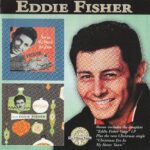
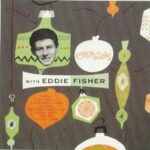
The cover of the original album is featured on the cover of the CD. The cover for I’m In The Mood For Love is also featured on the cover, along with a large picture of a smiling Eddie Fisher.  The original album cover features simply drawn Christmas ornaments of varying shapes and colors on a brown background.  The largest ornament, in the upper left, has a black and white picture of Eddie Fisher.  Other ornaments contain the rest of the album title.

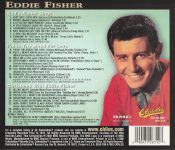
The back of the CD again shows a picture of a smiling Eddie Fisher.  Most of the space on the back is dedicated to a list of each original album with numerical track listings.  In addition, writer credits and time signatures are included with each song.  There are 8 songs for each album (originally 10” LPs), and one bonus Christmas song for a total of 25 songs.

The CD cover comes out and opens along three fold-outs, giving a total of seven more pages of additional information.  Once fully opened, the inside has five pages of the liner notes that were on the backs of all the original albums.  As far as the Christmas record goes, the exact same critique from the album is included in its entirety, word for word, albeit in a different font.  It gives a brief biography of Eddie Fisher’s career and some insights into the recording of this Christmas record.

Two pages, the front and the back of the last page, is a mail-in postcard for receiving a catalog from Collectables® Records.

The last page of text from the Christmas portion of the liner notes also contains information on the recording dates of all the songs included on the CD.  Also, copywrite notices are given and a web address for oldies.com.

There were 8 songs on the original LP, and this CD contains them all in their original order and even includes a bonus Christmas song from 1953.  Hugo Winterhalter & his Orchestra provide the lush arrangements and the backup chorus is the Hugo Winterhalter Chorus.

The song selection is a mix of traditional Christmas hymns, familiar secular Christmas songs and a few that are not so familiar.

The 1st song is Silent Night.  Tolling bells keep time while Eddie Fisher sings the lyrics solemnly.  After the first verse, Hugo Winterhalter’s mixed chorus joins with Eddie Fisher.  For the middle instrumental break, brass instruments join the bells.  The melody is primarily tolling bells with occasional brass instruments.  I cannot detect a string orchestra present.

The 2nd song is White Christmas.  The vocals are traditional, and the melody is carried by a light orchestra.  The mixed chorus adds wonderful harmony to Eddie’s vocals.

The 3rd song is probably Eddie Fisher’s most popular Christmas song.  You’re All I Want For Christmas should be a familiar Christmas song to most listeners, and that is most likely because of Eddie Fisher’s version.  It was a Top Thirty hit in 1953 on the Pop charts.  The song begins with a burst of strings and brass, which falls back as Eddie Fisher and the chorus begin the song in unison.  This song showcases Eddie’s wonderful tenor voice beautifully.  His phrasing is clear, and his rhythm glides up and down over the melody perfectly.  The arrangement is achieved with a full orchestra, but the music stays light.  The end is dramatic as the music stops, and Eddie Fisher and the chorus finish a cappella.

The 4th song, Christmas Day, I believe is an original Christmas song, unique to this album.  I have other versions of songs titled Christmas Day, but none, although there are different ones amongst them, are like this one.  The Hugo Winterhalter Chorus opens the song triumphantly, then disappears as Eddie Fisher begins the vocals.  The orchestrations are light, with piano, celeste and strings carrying the melody.  In the song, Eddie Fisher declares that his heart will be with his true love on Christmas Day.  He requests that a place at the table be saved for him because no matter what it takes, he will be there on Christmas Day.  The chorus echoes Eddie Fisher during the refrains.

The 5th song, That’s What Christmas Means To Me, is another original Christmas song unique to this album.  The arrangement is mostly strings with harp and celeste.  Eddie Fisher describes all the things, like seeing friends, greeting neighbors and seeing the star of Peace shine overhead that gives meaning to Christmas for him.

Here Comes Santa Claus (Right Down Santa Claus Lane) is one of the best recordings of this song, and yes, it is in my Top 500 Christmas Recordings.  Eddie Fisher’s vocals are solid and sincere.  The instrumental middle part borrows from Gene Autry’s version in that the reeds are matched with an accordion.  There are times, during the refrains, that the music becomes scarce, and Eddie Fisher and the chorus carry the melody on their own.

The 7th song, Jingle Bells, is delivered as well as all the others with light orchestrations and great accompaniment by the mixed chorus.  Reeds matched with an accordion open the song, and the vocals are primarily sung by the chorus.  It isn’t until the middle of the song that they drop out and Eddie Fisher sings the vocals all by himself.  The vocals are shared equally till the end of the song which ends triumphantly while the music trots out.

The last song on the original album is another song on this album that’s in my Top 500 Christmas Recordings.  That makes three off this album.  The song, O Come, All Ye Faithful (Adeste Fideles), is voiced more reverently than the others, but then again, the lyrics almost command it.  The arrangement features full orchestration with tolling bells and light celeste.  This is an endearing version of a Christmas Classic.

But wait, it’s not over yet.  This CD contains a bonus Christmas song from 1953,  Christmas Eve In My Hometown.  I think most people, if they are familiar with this song, probably know it from Bobby Vinton from his Christmas album in 1973.  I have many other versions, but Eddie Fisher does a terrific job on this one.  Hugo Winterhalter once again is in command of the orchestra, as is his chorus to assist.  The lyrics tell of a man yearning to be home for Christmas as the memories of Christmas Eve are pervasive.  He envisions all the grandeur and sights and sounds of Christmas Eve In His Hometown.

This is a terrific Christmas album recorded near the beginning of the Classic Christmas Music Era.  Hugo Winterhalter was an established orchestra leader, and he knew exactly how to keep the arrangements light and let Eddie Fisher’s voice shine through the melodies.

If you seek Classic Christmas albums and don’t already have this in your collection, you need to consider adding it.  This will appeal more to people born before 1970, but it should be welcomed by anyone who enjoys Christmas music.  Few singers today can match the strength and tone of Eddie Fisher’s voice.  Yes, I know there are a lot of names you could point out, but the style and inflection of Eddie’s voice was also due to the way Pop music was performed in 1952.

I give this CD :

*****

December 3, 2022

# 71

VA - All Time Christmas Favorites!
1994

Front
Back

GSC Music Distributed by Entertainment Distributing – © 1994 EDI Package Design by: Jerry Wiant Design

Genre : Pop Vocals

This is all the Christmas music you should ever need, unless you are as obsessed with collecting Christmas music as I am, or you seek out an individual artist’s Christmas CD.  This is a five CD set of wonderful Christmas music.  This terrific set comes from GSC Music.  They are a small record label that specializes in releasing compilation CDs of singular artists or compilation CDs of mixed artists, such as this one.  This is probably their largest single collection.  Many of their multiple CD sets are three discs.  This is five.  That’s a lot for any Christmas compilation set.  This is probably the largest single box set I have in my collection.  The Time-Life Music sets are usually two CDs and the Readers Digest sets are usually three, but to offer five is incredible.

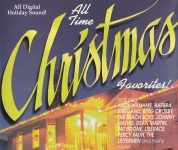
The set comes in a box that is the same size as is used for three CD sets.  They put in another tray which allows the box to hold two more discs.  The cover of the box features a 1950’s style suburban house all lit up with Christmas lights.  At the top of the CD cover, in small letters, are the words “All Time” and below, in very large yellow-green letters is the word “Christmas” and directly below, “Favorites!”  The bottom corner features a small list of the artists featured throughout all five CDs.

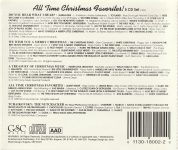
The back of the CD is mostly a numerical track listing with performing artist credits listed in sentence form for each CD.  This five CD set is actually five separate CD releases packaged into one set.  Each CD has its own title and copywrite year of release.  Each CD features its own numerical track listing.  All are compilations of mixed artists and styles of Christmas music except the fifth CD.  The fifth CD is all The Royal Philharmonic Orchestra performing Tchaikovsky : The Nutcracker.

The CD title appears at the top of the back of the CD in bold lettering.  At the bottom are label and copywrite notices.  Also, the letters AAD.  As familiar readers know, I love AAD.  AAD stands for Analog – Analog – Digital.  And I assume it applies to all the songs.  That means that these are all the original, label release Christmas songs from albums or singles.  That’s want you want to look for.  No re-recordings here.  All are great Christmas songs recorded during the Classic Christmas Music Era (1946 – 1976)

Unfortunately, this budget CD set doesn’t contain a multiple page booklet with artist, orchestra or recording information.  That would have been a super deluxe bonus. (And another ½ *).  I have some three CD sets that have small books of information included, but alas, not this one.

Not to worry too much.  These are all popular artists performing familiar Christmas songs that are easily traceable to their individual Christmas albums and with some cross referencing in my library, I can pretty much put years, orchestras and backup singers to most of these.

The individual CD titles are :

CD 1 : Do You Hear What I Hear?                                                                                                                      (P) © 1985, 1988 Sony Music Special Products                                                               

CD 2 : We Wish You A Merry Christmas                                                                                                              (P) © 1987 Capitol Records, Inc.

CD 3 : A Treasury Of Christmas Music                                                                                                              (P) © 1981 Sony Music Special Products

CD : 4 All Time Christmas Favorites                                                                                                                  (P) © 1988 MCA Records, Inc.

CD 5 : Tchaikovsky : The Nutcracker                                                                                                                (P) 1986 The Special Music Company

Four different record companies are represented here.  That means we are getting a broad spectrum of Christmas artists.  There is little repeat of artists spread throughout the collection.  Bing Crosby has the most, around six, Barbra Streisand, Liberace, Pat Boone and Mahalia Jackson each have two.  With that said, practically everyone who was known for their Christmas records is represented here with at least one song.

There are Pop Vocalists such as Andy Williams, Johnny Mathis, Robert Goulet, John Davidson, Doris Day and Peggy Lee.  There are Classic Country artists such as Tammy Wynette, Ray Price, Glen Campbell and Johnny Cash.  There are Symphonic Christmas songs performed by Andre Kostelanetz, Percy Faith and Carmen Dragon And The Hollywood Bowl Symphony Orchestra.

There are Christmas songs from artists that are not really known for their Christmas albums.  These include Anita Bryant, Jimmy Dean and Tennessee Ernie Ford.  Vocal groups such as The Lettermen, The Brothers Four and The Beach Boys are here as well.

Choral groups known primarily for their Christmas music include The Ray Conniff Singers, The Pennsylvanians, Mitch Miller & The Gang and The Percy Faith Chorus.  The Mormon Tabernacle Choir, James McCracken, Jackie Gleason and The Do-Re-Mi Sing Along Children’s Chorus are all here as well.

The fifth CD is dedicated to The Royal Philharmonic Orchestra performing Tchaikovsky : The Nutcracker.  I have many single and double CDs of known symphony’s (and some not so well known) performing Tchaikovsky’s The Nutcracker.  (I kind of collect those too.  You can find a list of all my Tchaikovsky: The Nutcracker CDs under the Lists tab.)

As would be expected, it is almost a full hour of a beautiful performance of The Nutcracker spread over 15 titles.  The instrumentation is just magnificent!  The Royal Philharmonic Orchestra was started in 1946 by Thomas Beecham. And through a lot of disharmonies through the years and perseverance, the Royal Philharmonic Orchestra still performs around the world today.

For most people, if you can track this CD set down, this is all the Christmas music you should need.  70 selections of familiar Christmas songs spread out over more than 3 ½ hours.  When the last CD has played, start it over again.  If it’s an active group where guests are coming and going and not really paying attention, they’re not going to remember if they already heard it or not.

If you are looking for a small collection for your own enjoyment around the house while getting ready for the Holidays, this will put you and keep you in the spirit for many hours.

But you won’t hear any Mariah Carey, Faith Hill, Jim Brickman or Josh Groban.  All these are from between the years 1942 and 1973.  If your tastes run more to today’s music, or if you’ve never heard these songs before because you’re only accustomed to Christmas music on the radio, you may find this boring.  But you probably won’t.

Anyone who enjoys all kinds of Christmas music will love this.

I give this CD :

*****

November 26, 2022

# 67

Patti Page
Christmas With Patti Page
2004

(Originally released 1965 on Columbia)

Back

© 1965, 2004 Sony Music Entertainment Inc. / Originally Released 1965 Sony Music Entertainment Inc. / Manufactured by Sony Music Custom Marketing Group / “SONY Music” is a trademark of Sony Corporation
Originally released as Columbia Records CS 9214

# 60 – 1965 – Billboard Christmas

Genre : Pop Vocals

Patti Page was born Clara Ann Fowler in Claremore, Oklahoma in 1927.  Her family was poor and quite large; Mom, Dad and 11 children.  Patti Page didn’t spend her younger years as a girl singer in Big Bands like so many of her contemporaries did.  Instead, she started singing on the radio at local stations around her hometown.  She was heard by Jack Rael, the manager of a touring Big Band.  He was impressed with her talent and asked her to join the band.  This was in 1946.

After a year with the Jimmy Joy Band, Patti Page found her way to Chicago.  It was here that Patti Page received her first recording contract with Mercury Records.  It was at Mercury Records that she began working with Mitch Miller.  It was also the same time that a musician’s strike was going on and no backup singers were available.  An engineer at Mercury Records developed a way to over-dub Patti Page singing her own backup harmonies.  They layered Patti’s voice over four times, and she became the Patti Page Quartet.  She would use this recording technique throughout her career.

It was at Mercury Records that she enjoyed most of her success.  Her signature song, Tennessee Waltz, recorded in 1950, was, and still is, one of the biggest selling records of all time.  Other hits Patti Page enjoyed at Mercury Records were (How Much Is That) Doggie In The Window (1953), Cross Over The Bridge (1954), Allegheny Moon (1956) and Old Cape Cod (1957).  She had many, many hits throughout the 1950s and was the best-selling female artist of the decade.

In the early 1960s, her career was starting to fade, and she signed a recording contract with Columbia Records.  During this time, she continued to record albums and had some small successes.  By 1970, she left Columbia Records and rejoined Mercury Records and started to focus on Country influenced recordings and had many more hits on Billboard’s Country charts.

This CD is a reissue of Patti Page’s third Christmas album.  The first was released in 1951 and was titled Christmas With Patti Page.  It was a 10” LP and contained 8 songs.  In 1957, Patti Page expanded on it by adding 4 new songs and released it as Christmas With Patti Page.  The Christmas album I’m reviewing right here, also titled Christmas With Patti Page, was released when she was at Columbia Records, in 1965.  Patti Page would release yet another Christmas CD in 2002.

With all her early Christmas output being titled Christmas With Patti Page, the only way to tell them apart is to look at the cover and song selection.  This reissue has all the songs from the original album, and all are in their original order.  11 songs are included and all except for Little Drummer Boy and Happy Birthday, Jesus (A Child’s Prayer) are secular Christmas songs, most from the 20th century, and all except two will be familiar Christmas songs.

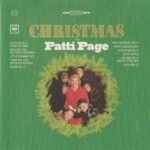
This CD reissue of Patti Page’s Christmas album from 1965 replicates the original album cover exactly.  The cover shows Patti Page surrounded by the children featured in the children’s choir that sing on this album.  It is a small picture centered on the front cover and surrounded by light green evergreen branches.  The album title takes up a large space above the picture.  The songs featured on the album appear at either side of the album title.

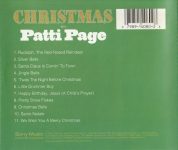
The back of the CD does not replicate the back of the album in any way.  On the CD, the back artwork has the CD title, again at the top, but this time it sits off to the left.  Below is a numerical track listing.  All is presented on the same green background as on the cover, but there are no additional decorations or artwork.

The front cover comes out and opens along a single fold-out.  It is here that the back of the original album is reproduced.  They did a good job of duplicating the back of the album very well.  But the information is spread over two pages whereas on the back of the album, which is a 12” by 12” square, the content was laid out slightly different.  The large print album title is missing, but the festive holly leaves surrounding the border are here.  The numerical track listing is reproduced accurately, but on the CD, it uses two columns whereas on the album, it was in one.  Also, on the album, next to the song titles, were the arrangers’ credits, and on the CD, those are omitted and in their place are song writer credits.  The personal note from Bob Johnston, the producer, is also here, albeit in two columns as opposed to the original, which was in one.  Some of the small details from the LP have been omitted but they are original release notes, so I guess that’s okay. 

The back of the CD cover is plain green, the same green found throughout the CD artwork.  There is only a small release number of A 14080 at the very top left.

The CD begins with a wonderful, light version of Rudolph, The Red-Nosed Reindeer.  The arrangement is accented with sleigh bells and the children’s chorus.  Bob Johnston uses a small orchestra absent of strings or brass.

The 2nd song, Silver Bells, features an introductory verse that I am not familiar with.  It was probably written just for this introduction.  Vic Schoen & his Orchestra employ a string orchestra to provide the melody.  The arrangement is lush and features festive instruments such as bells and cascading strings to keep the song festive.  Patti Page’s vocals glide over the rhythm effortlessly.

The 3rd song is Santa Claus Is Comin’ To Town.  Once again, Bob Johnston & his Orchestra relies on bells, chimes and wood blocks to keep the mood festive.  All the songs feature a children’s chorus, and it gives the whole album a child-like feeling.  The chorus is not there just to add background harmonies; they also get involved with adlibs and Christmas greetings only as children can.

Jingle Bells, the 4th song, also features a light arrangement of sleigh bells, chimes  and wood blocks.  While the music softly fades in, Patti Page’s vocals are bright and festive.  The children’s chorus joins in for the choruses.

The 5th song features a unique structure.  ‘Twas The Night Before Christmas features Vic Schoen & his Orchestra providing an orchestra of cascading strings, while bass guitar and marimba provide festive accompaniment.  While providing the melody, the instruments are also employed to imitate the sounds and actions of the words themselves.  Patti Page delivers the song in spoken word as opposed to singing the lyrics.  This method is employed by other artists as well with this song and always to great effect.  Because the lyrics are spoken instead of sung, Patti Page’s Texas dialect is more noticeable.

The 6th song, Little Drummer Boy, is of course more somber than the previous songs.  The arrangement is traditional in the sense that it uses the snare drum and “rump-pa-pom-poms” as found on many versions.  As the song progresses, the instruments become more involved.  Patti’s vocals are somber, and the children’s chorus is here to give the song an added softness.

The 7th song is a rare and unusual Christmas song.  Happy Birthday, Jesus (A Child’s Prayer) is a Christmas song written in 1958 by George Donald McGraw.  There are a few recordings of this floating around.  I have three; the original recording by Little Cindy in 1958, one from Burl Ives recorded in 1968 for his Christmas album and this one from Patti Page, from 1965.  There are a few other versions out there but most of them are recent recordings and directed at the children’s market.  Even though it is a children’s song, it makes for a wonderful Christmas song.

Happy Birthday, Jesus (A Child’s Prayer) is most often a spoken word song.  It uses the melody of Silent Night, and the prayer is as if it is being prayed by a child.  The version presented here opens with light orchestration for the opening introduction and then ceases as Patti starts her recital.  For quite some time, it is just Patti Page speaking and the children’s choir oohing along.  Slowly, and with little recognition, a chime is heard, then a flute, and then the light string orchestra begins.  As the song progresses, the children’s choir grows louder, the orchestra grows larger and for the end of the ‘song’, chimes fade the song away.  This song needs to be heard to be appreciated.  I have it in my Top 500 Classic Christmas Recordings because it’s an unusual Christmas song and it tells of the true meaning of Christmas.

The 8th song, Pretty Snow Flakes, is another terrific original Christmas song.  Belford C. Hendricks & his Orchestra are in command of this light waltz arrangement.  Electric and acoustic guitars accompanied by a piano and celeste start the song.  After the first verse, the children’s choir begins and stays throughout the song giving it a very childlike feeling.  The song speaks of how beautiful it is the day after a snowfall, and the day just happens to be Christmas Day.  As the song progresses, the piano continues the melody while Patti Page’s vocals glide softly through the lyrics.  This is another Christmas song that needs to be heard to be appreciated.

The 9th song, Christmas Bells, is also arranged and conducted by Belford C. Hendricks.  The arrangement uses the same instruments as in the last song, so it has the same light appeal.  The melody is light, and the celeste and bells are here to keep it festive.  But what really makes this song special is the children’s choir.  Their harmonies echo Patti Page’s vocals.  It presents itself more of a children’s song, but I still look at it as a terrific Christmas song.

Santo Natale is the 10th song.  It’s not a popular Christmas song, but it should be familiar.  The song stays true to the original arrangement and the melody is produced with a full string orchestra.  Our children’s chorus stays with Patti Page all through the song.

The last song on the album is the fitting We Wish You A Merry Christmas.  It is used often as the last song on older Christmas albums.  Bob Johnston & his Orchestra provide the instrumentation.  There is no heavy string orchestra, but rather a light orchestra that features bells to great effect.  I should save the ending for you to find out on your own, but I will go ahead and tell you that the children end the song with their personal wishes to Patty, and then to the listener.  Classic.

It is only fair to say that this Christmas CD comes across as a children’s record due to the large presence of the children’s choir.  Don’t get me wrong, they are terrific and really make this a festive Christmas record.  It’s just not what you saw much of back in 1965.  Yes, there were children’s choruses, Hugo & Luigi, Norman Luboff and even Guy Lombardo were known to use them.  But they used them more formally.  Here they are used to convey a certain Christmas idea that Christmas will always be for children, no matter if they’re 8 or 88.

If you can’t tell by now, I like this CD reissue of Patti Page’s 1965 Christmas album very much.  For one, it’s Patti Page, who is a terrific singer.  Also, it’s from 1965.  And lastly, the children’s choir makes this a unique and special Christmas album.

Of the 11 songs on here, 4 are original, unique and unfamiliar Christmas songs.  To me, that too is a plus.

With that said, I don’t think this would have mass appeal to a large crowd in today’s market.  I think most listeners will tolerate a song or two occasionally, but to play the whole thing through, I think would bore most listeners.  Mainly because of the children’s choir.  They will think you put on a children’s record.

So, you have your Bing Crosby, Johnny Mathis, Perry Como and Rosemary Clooney.  Those are the ones that people will make requests for, but this is nice to mix in with the others in small doses.

Most songs have light arrangements that rely on bells and chimes to keep it festive.  This is not a CD that is full of lush string orchestras and brass trumpets.  Those instruments are featured more on the Vic Schoen arranged tunes, but even then, the music never overwhelms Patti Page or the children’s choir.  I’ll say it again, I like this Christmas CD for all the right reasons.

I give this CD :

****

November 6, 2022

# 58

VA - 15 Christmas Favorites
2003

(Originally released 1989 as Christmas By The Fireside on Capitol Records)

Back

This compilation (P) 1989 © 2003 EMI Music Special Markets
Manufactured by EMI Music Special Markets

Genre : Pop Vocals

This is a very good Christmas compilation CD.  I am very familiar with it because I play it often.  This was originally released in 1989 on Capitol Records as Christmas By The Fireside and has been re-released numerous times under different titles.

There are 15 wonderful Christmas songs on here, and all are secular Christmas titles familiar to most people.  None would be considered traditional Christmas carols or hymns.  Two songs will probably be unfamiliar, but all are sung by artists that should be familiar to people who like Christmas music.

The CD cover is atypical, but it is pleasant.  In the foreground is an evergreen conifer and, in the background, a few more, all in a snow-covered field on an overcast winter’s day.  The CD title, 15 Christmas Favorites appears at the top right in white letters.  At the bottom right, in red letters, is a list of some of the artists on here.

The artwork on the back of the CD features a closer image of the same evergreen tree found on the front cover.  Superimposed over the background image is a numerical track listing featuring the performing artist on the right half of the back cover.

It is not necessary to remove the CD cover to gain any new information.  The CD cover is a single sided piece of paper.  In fact, there’s no need to take the cover out at all because the back of the cover is completely blank.  I was disappointed with the lack of any real information.  The only place we get song titles or performing artists is on the back of the CD.  And we don’t get writer credits at all.

Because of redundancy in my Christmas music collection and a little investigation with the sources I use, I was able to put years and orchestras to most of these songs.  Most of the songs are from the 1960s and four are from an earlier time.

The CD begins with Nat King Cole singing The Christmas Song.  This version is from 1960 and was included on Nat’s Christmas album in 1961.  The beautiful arrangement is provided by Ralph Carmichael & his Orchestra.  Mel Torme and Robert Wells wrote this Christmas classic, but Nat King Cole made it his own.

The 2nd song, Let It Snow! Let It Snow! Let It Snow! is sung by Bing Crosby.  This appeared on Bing’s Christmas album from 1962.  It is one of the few times Bing Crosby has recorded this song.  Even though it was on Bing’s 1962 Christmas album, and I have a copy of it, I can’t find the orchestra leader for this.  I know who led the orchestras on the 1962 Christmas album, but I don’t know which songs each arranger led.  Bummer.  (May have to dig deeper, but I’ve exhausted all the avenues I’m aware of).  Nonetheless, Bing does a great job with crisp vocals along with a soft, lush melody.

Jack Parnell & his Orchestra help Lena Horne produce a terrific version of Winter Wonderland from her 1966 Christmas album, Merry From Lena.  The arrangement is jazzy, punctuated with piccolos.  The melody swings and the brass instruments come along near the end to finish the song.

Lou Rawls contributes Have Yourself A Merry Little Christmas, from his 1967 Christmas album.  H. B. Barnum & his Orchestra provide a jazzy arrangement of light piano, bass and trumpets.  In the middle of the song, a xylophone is heard until the brass comes back in.  In the background you notice a nice lead jazz guitar.  This song is Lou Rawls’ most popular Christmas song, and it is my Top 500 Classic Christmas Recordings.

The 8th song, I’ve Got My Love To Keep Me Warm, is an instrumental from Les Brown & his Orchestra and it is the oldest song in this collection, recorded in 1948.  It was a # 1 hit for Les Brown on the Pop Charts.  This arrangement swings like Big Band music should.  It is a very popular Christmas song and appears on a lot of Christmas compilation CDs.

The 10th song, Happy Holidays by Peggy Lee, is a fast-paced arrangement of music, but Peggy Lee’s vocals are at an even pace.  It is an unusual arrangement, and I think this is the only version I know of that combines Latin percussion with a traditional orchestra.  Sid Feller & his Orchestra provide the musical enjoyment.  This was recorded in 1965 for Peggy Lee’s Christmas album that year.

The 11th song, Our Winter Love by The Lettermen, is not really a Christmas song, but it is a very nice song.  Surprisingly, it was not included on their 1966 Christmas album, but rather it was released as a single, going as high as # 16 on Billboards Adult Contemporary charts in 1967.  The song speaks of someone who found his true love in Winter.  The Lettermen were known for their elaborate harmonies, and they definitely showcase them here with this song.

Nancy Wilson delivers That’s What I Want For Christmas, from 1963.  O. B. Massingill & his Orchestra provide a soft arrangement.  Nancy Wilson’s vocals float over the rhythm in a soft, jazzy manner.

The 13th song, Love Turns Winter To Spring by The Four Freshmen, is not a Christmas song either.  I find it ironic that two of the biggest vocal harmony groups of the 1960s have songs on here, but neither are Christmas songs.  Both The Lettermen and The Four Freshmen recorded Christmas songs; they’re just not represented on this CHRISTMAS compilation CD.  The Four Freshmen were considered one of the finest collegiate vocals groups there ever was, based on their intricate harmonies.  I can hear the separate voices, but to me it sounds like a couple of them are off key.  I think it was intentional, I just don’t find it very pleasing to the ear.

The 14th song, Baby, It’s Cold Outside, is a duet between Margaret Whiting and Johnny Mercer and it’s the other song on here from the 1940s.  It was recorded in 1949.  As with most of Johnny Mercer’s recordings, Paul Weston & his Orchestra provide the light arrangement.  Coming from 1949, the song has a Big Band arrangement, and Margaret Whiting and Johnny Mercer balance their vocals in an endearing manner.

The CD closes, as all Christmas celebrations should, with Auld Lang Syne, performed by the master himself, Guy Lombardo And His Royal Canadians.  You can imagine that the man who made this song famous would have recorded this song many times, and you’d be right.  This version comes from 1956, and it is the most popular version.  If you’re hosting a New Year’s Eve party and want to play Auld Lang Syne by Guy Lombardo, then this is the version you want.  The “Lombardo” sound was achieved by matching the clarinets and the saxophones, accompanied by trumpets with a cascading piano melody clearly heard.

I did not reference every song on this wonderful Christmas compilation CD, but I can highly recommend it.  Out of the 15 songs presented here, 8 can be found in my Top 500 Classic Christmas Recordings.  This is an almost perfect Christmas CD.

I say that because the two songs that are not Christmas songs could easily have been replaced with Christmas songs by those same artists, as discussed earlier.  And the off-key Four Freshmen song just disrupts an otherwise perfect Christmas CD.  Other than that, if you are just starting a Christmas music collection and don’t want to spend a lot of money, go ahead, seek this out, you won’t be too disappointed.

Even with a couple of faults, this CD should appeal to a wide audience, young and old.  Most songs are traditional Christmas songs performed by familiar artists.  This would easily provide at least 38 minutes of enjoyable, festive Christmas music.

I give this CD :

****
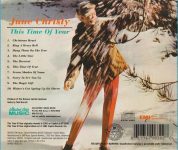
November 6, 2022

# 57

Sinatra Family
The Sinatra Family Wish You A Merry Christmas
1999

(Originally released 1968 on Reprise Records)

Back

(P) © 1999 Bristol Production Limited Partnership
Manufactured by DCC Compact Classics, Inc.

# 3 – 1969 – Billboard Christmas

Genre : Pop Vocals

The Sinatra Family Wish You A Merry Christmas, and boy do they!  The Sinatra Family combines Frank Sinatra, his daughters Nancy Jr. and Tina, as well as Frank Jr.  All three children have the same mother, Nancy Barbato Sinatra.

Nancy Sinatra was born in 1940.  Nancy Jr., (as she’s referred to on this CD), started releasing singles in the early 1960s, and had her first huge hit, These Boots Are Made For Walking, in 1966.  She would go to have a prolific recording career.

Tina Sinatra was born in 1948, and her recording career seems to be limited to this album.

Frank Sinatra Jr. was born in 1944.  Frank Jr. (as he’s referred to on this CD) also started his recording career in the mid-1960s.  Frank Jr.’s recording career was more prolific in the 1980s and 1990s, after Nancy’s career had tapered off.  While Nancy Sinatra recorded more contemporary songs, Frank Jr. sang Pop standards.

This CD is a reissue of The Sinatra Family’s Christmas album from 1968 and is produced by Bristol Production Limited Partnership and DCC Compact Classics.

The cover of the CD is the same exact image as used on the original album.  It shows Frank Sr. with Tina, Nancy and Frank Jr., all dressed in white, huddled together against a white background.  The album name runs across the top of the image in fancy script.  The same font from the original album is used on the CD reissue.

The back of the CD resembles the back of the album only slightly.  The artwork on the back of the CD uses the same family portrait that appears on the cover, albeit a much smaller image.  The name of the CD is near the top and is in the same font as on the front cover.  Below the CD title is a numerical track listing with time signatures.  Below each song title is the performing artist, listed for each song.  Orchestra and production credits are listed for the original album.

The CD cover comes out and opens along a single fold-out.  Inside, the CD title runs across the top of both pages.  On the left side is a numerical track listing just as on the back of the CD, minus the time signatures, but it does include performer and writer credits.  The right side of the fold out contains notes on the original producer, orchestra, chorus, etc.  Also included are production notes for this reissue, as well as copyright notices at the bottom.

The back of the CD cover is an exact copy of the back of the original album.  It shows The Sinatra Family, still dressed all in white, but in different positions.  Tina and Nancy are standing in front of a seated Frank Jr. and Frank Sr.  The album title is at the top in the same script featured throughout all the artwork.  The songs are listed next to the standing daughters and production notes are listed below Frank Jr. and Frank Sr.

The artwork for the CD reissue is very good.  We get the front and back of the original album.

There were ten songs on the album and all ten are here, in their original order.  Nelson Riddle & his Orchestra handle all the instrumentation on all songs except Whatever Happened To Christmas where Don Costa & his Orchestra provide the music.  The Jimmy Joyce Singers provide the wonderful chorus throughout the CD.

There are two traditional Christmas carols, four familiar Christmas songs and four songs that appear to be original to this album.

The CD begins with one of those original Christmas songs.  I Wouldn’t Trade Christmas is sung by the entire Sinatra Family.  The arrangement has a Ray Conniff feel to it, but Nelson Riddle was known for sweet, lush arrangements just as well.  It is a fun Christmas song describing all the great and not so great Christmas traditions that make Christmas something to look forward to every year.  The Jimmy Joyce Singers provide layered choral harmonies.

The 2nd song, It’s Such A Lonely Time Of Year features Nancy Sinatra.  It is no surprise that she enjoyed a successful career, she has a good singing voice.  This is a sentimental song about a woman who is left to take care of her children by herself.  It is obvious that she is heartbroken.  Clues in the lyrics indicate that her husband divorced her.  It’s not much of a Christmas song.  It mentions Santa Claus once and talks of trimming the tree, but it is more of a heartbreak song that could be played any time of the year.  Nelson Riddle provides a somber arrangement that suits the lyrics well.

Frank Sinatra Jr. does a fine, fine job with the 3rd song, Some Children See Him.  It is one of my favorite Christmas songs.  The instrumentation is light, mainly an acoustic guitar.  Frank Jr.’s vocals are soft and endearing, but it is the Jimmy Joyce Singers providing lush choral voices that really make this version special.  Overall, the song speaks of how different children see Jesus in different ways.  More specifically, they see Jesus as they see themselves.  Andy Williams sings my favorite version of this somber Christmas classic.

Tina and Nancy share a duet with the 4th song, O Bambino (One Cold And Blessed Winter).  It is a familiar Christmas carol to me but it may not be to a lot of people.  It is partially sung in Italian.  The arrangement is light, featuring strings and light brass instruments.  The girls do a great job with the lyrics, and once again, the Jimmy Joyce Singers are there to provide soft harmonies.

The 5th song, The Bells Of Christmas (Greensleeves) is a Family affair.  The song is really Greensleeves, or also known as What Child Is This?  This version has new lyrics adapted by Sammy Cahn and Jimmy Van Heusen.  This is one of my favorite Christmas songs of all time.  It is in my Top 500 Classic Christmas Recordings.  Frank Sinatra begins the song, then Nancy sings the second verse.  The Sinatra Family are all present for the refrains.  Nelson Riddle does a superb job with the orchestral arrangements.  The song speaks of the glorious sound of bells heard coming from the church steeple and in so, declaring Christmas as the season of love.

The 6th song, Whatever Happened To Christmas, is an original Christmas song written by Jimmy Webb.  Frank Sinatra sings this sad, somber Christmas song by himself.  Frank reflects on whatever happened to the Christmases he once knew.  As he ponders all the things that seem to be missing in today’s Christmas celebrations, at the end of the song it is revealed that these things are missing because he and the woman he shared them with have drifted apart.  This is the only song on the album that features Don Costa & his Orchestra.

For the 7th song, Santa Claus Is Comin’ To Town, Tina Sinatra has the vocals all to herself.  Except for the Jimmy Joyce Singers who provide joyous harmonies.  Tina was 20 at the time this was recorded, and she provides an adolescent feel to the vocals.  It features an upbeat, mid-1960s Pop arrangement.

The 8th song, Kids, is an unfamiliar Christmas song.  I have three versions by other artists, but it is still an unfamiliar song.  Nancy Jr. sings of how Christmas is for Kids, from 1 to 93.  She sings of how the wonder of Christmas makes everyone feel like a kid again.  It has a slow tempo and Nelson Riddle provides a soft, somber arrangement.

Frank Sinatra solos once again on the 9th song, The Christmas Waltz.  It is a lush arrangement with the Jimmy Joyce Singers providing wonderful harmonies.  This is a popular Christmas song by Frank Sinatra.  He has recorded this many times.  This may be his best one yet.

The last song, The 12 Days Of Christmas, is performed by The Sinatra Family.  It is a fun song.  Each verse is sung by one of the children, rotating until the fourth day when they sing the rest of the days together.  The lyrics we are all familiar with have been changed to reflect the different gifts they gave their dad, and the numbers of each gift received.  Frank Sr. comes in for the last verse to sing of all the twelve different gifts he got.  Everyone seems to be having a good time on this.  It may not become a classic Christmas song, but it has a great twist to the original lyrics and must be heard to be appreciated.

Frank Sinatra was at the top of his game in 1968, and this is his last Christmas album he recorded.  A lot of the songs on here, at least the original songs, are a little sad in nature, and sung in a dour mood.  That is not to say that they are not good Christmas songs.  They all deliver the message of a Merry Christmas, and it makes for a more personal Sinatra Christmas album.

Frank Sinatra teamed up again with Nelson Riddle for this album.  He started working with Nelson Riddle in 1954 when he signed with Capitol Records, but when Frank started his own label, Reprise Records in 1961, he started working with other arrangers.  The combination of Frank Sinatra and Nelson Riddle has always produced Frank’s best albums.  The orchestra is in great form and provides lush strings and light brass for all the songs.

This is not a Christmas CD with 10 songs that will delight everyone.  Very few of the selections are familiar to a lot of people.  There are some good Christmas songs, but there are also a few that might take the joy out of the moment.  This is best mixed in with a large playlist, and if the mood isn’t fit for it, you can skip the one or two really sad songs.  But do not skip The Twelve Days Of Christmas.

If you like Frank Sinatra singing Christmas songs and don’t have this in your collection, you should consider adding it.  I Wouldn’t Trade Christmas, The Bells Of Christmas (Greensleeves) and The 12 Days Of Christmas are all worth the price of admission.

I give this CD :

****