
January 7, 2023
# 97
Orquesta De La Luz
Feliz Christmas!
1994
(P) 1994 BMG Entertainment
The BMG Logo is a trademark of BMG Music. Manufactured by BMG Special Products, a unit of BMG Entertainment.
Genre : Salsa
This is gonna be a hoot! I don’t know where to begin. This is a great (!) Christmas CD by the Salsa band, Orquesta De La Luz. That in itself is unusual. At least for most of you out there. How many Salsa Christmas CDs do you have? I have many. 😊
The other unusual aspect of this terrific Salsa band is that they are from Japan. Yes, Japan. There 10 Japanese musicians playing the most authentic Salsa music found anywhere in the world. I would guess, even in Puerto Rico or Nicaragua, Orchestra De La Luz could give any of the more well-known native Salsa bands a run for their money.
Interestingly, throughout the years, the group has gone through a lot of different members. I find it hard to imagine finding that many native Japanese musicians well versed in Latin rhythms. The band started in 1984 and was a big success in their homeland. During a trip to New York in 1989, the band was able to secure a recording contract. Their first CD was released in 1990 on RMM Records in the United States and Ariola in Japan, and simply titled, De La Luz.
Their first CD topped the Billboard Latin charts for 11 weeks. The band took tours of the eastern US seaboard, including New York, Boston, Miami and Puerto Rico. The band was well received everywhere it went, including tours of South America.
Over their first 8 years together, the band toured relentlessly and won awards all over the world with every album release. Oh, did I mentioned they sing in Spanish? A Japanese band playing Afro Cuban music and singing in Spanish. What will they think of next? Maybe a Christmas album? I love it! 😊
Over the years, many members came and went and were replaced with new members. In the mid-1990s, they changed their sound more to Jazz and soft ballads. This did not set well with Nora Shoji, the lead singer and constant member. After the band broke up in 1997, Nora Shoji returned to Salsa in her own recordings.
The band got back together in the early 2000s, but I still prefer the sound they had in their first 8 years.
I was already familiar with the band before I bought this Christmas CD because I like Salsa and I have a lot of Afro Cuban music going all the way back to the 1930s. I don’t speak a word of Spanish, but I do like the Afro Cuban rhythms very much. I learned to play congas a little and played out in local bars briefly in the 1990s. Now I just mainly listen to it. You must pick your battles, and I picked collecting Christmas music.
So, when I saw that Orquesta De La Luz recorded a Christmas album, I could not buy it quickly enough. Orquesta De La Luz is one of the best Salsa bands ever. Their musicianship is tight, the Mambos are top notch, and the vocals are perfect.
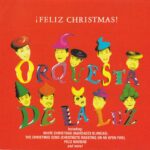
The cover art for the CD is very festive. The CD title appears at top and the band’s name appears in large multi-colored, slightly twisting letters in the center of the CD. Hand drawn faces of the band members are placed atop some of the letters. A few song titles are listed towards the bottom. All is presented against a red background and produces a very colorful cover.
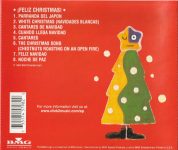
The back cover of the CD features the CD title and directly below, a numerical track listing in the upper left corner. There is a simply drawn, Mayan influenced Christmas tree in gold and green off to the right. Again, all is presented against a red background.
The back of the CD cover is nothing special. It features the CD title and band name above a numerical track listing. The list is superimposed over a faint image of the Christmas tree from the back cover. All is presented in black and white. At the bottom is a BMG copywrite notice and the band’s web address.
There are only 8 Christmas songs on here and the CD only takes 33 minutes to complete. But I’ll take it. It’s the only Christmas album Orquesta De La Luz will probably ever release.
As I said, I don’t speak or read Spanish. It’s hard to recognize some song titles and others are easier because they are in English. Without any writer credits, it’s hard to tell if there are any original Christmas songs on here. I’m inclined to think there are. The Japanese release has a different track order and includes one bonus track.
The CD begins with Parranda Del Japon. The song features a Mambo arrangement. A parranda is a Puerto Rican music tradition that takes place during the Christmas season. The song stays true to its Mambo roots, and the dancing never stops.
The 2nd song, White Christmas (Navidades Blancas), is again a Mambo. The three basic Afro Cuban rhythms in the son style can be described as Bolero, Cha Cha and Mambo, with the Bolero being the slowest and Mambo being the fastest. The vocals for White Christmas (Navidades Blancas) begin in English and are traditional in all respects. The music is another story. The Mambo rhythm rolls quickly in the background over Nora’s solemn vocals. After the middle instrumental passage, the lyrics are sung in Spanish. I was pleasantly surprised to hear the celesta chiming in the background. Not a traditional Afro Cuban instrument, but certainly a traditional Christmas music instrument. I like the way Orquesta De La Luz added the celesta into the Mambo arrangement.
The 3rd song, Cantares De Navidad, again features a Mambo. The opening features an acoustic guitar as Nora Shoji sings the vocals and the band members provide terrific response harmonies. The melody features all the Latin percussion instruments driving the rhythm while the brass section plays the melody during the instrumental breaks. Typical Mambo structure.
The pace slows considerably with the 4th song, Cuando Llega Navidad. The arrangement features the Bolero. A smooth, slow Latin rhythm that’s easy to dance to. Nora Shoji takes the vocals all by herself while strings provide a lush background. And there’s that celesta again. Excellent. Take traditional Latin rhythms played with traditional Latin instruments and then add in the celesta and a full string orchestra, and you have a mix of cultures and genres that can’t be found anywhere else.
Another Mambo, pushed ahead with the brass section, opens the 5th song, Cantares. The arrangement is festive, and the band cheers the refrains in between Nora’s strong vocals. The rhythm is quick, and the congas and timbales are going strong.
The 6th song, The Christmas Song (Chestnuts Roasting On An Open Fire) again features English vocals, this time for the entire song. The rhythm is a Mambo, and the percussion department is spot on with this one. The brass section is there to add flavor in the instrumental middle part. After a traditional first half, Nora adlibs the vocals in a jazzy manner. The arrangement breaks tradition and stays this way for the rest of the song. I hear the strong influences of Sharon Jones And The Dap-Kings on here. Is it possible? Perhaps, but here Orquesta De La Luz takes traditional Latin rhythms and adds a Jazz flavor. Very unique.
The 7th song should be expected, I guess. Feliz Navidad is already the most common and perhaps the only Spanish Christmas song known to most everybody, and here it is given the Orquesta De La Luz treatment. The arrangement features a very fast Mambo rhythm. Short on vocals, much of the song is instrumental and the brass section gives way to a great piano solo in the middle part.
The CD closes with a surprise song that just blew me away. Oh my gosh! The song, Noche De Paz, begins as a solemn, soulful a cappella arrangement for the first half of the song. It’s not a Mambo; it’s not a Bolero. It’s just beautiful vocals singing a cappella. The rest of the band does a tremendous job with the oohs and aahs in the harmonies. The first half of the song is sung in Spanish. For the second half, the band is joined by soft strings that are barely discernable, and the lyrics are sung in Japanese. It’s an interesting take on Silent Night if I must say so.
This Christmas CD may not appeal to a lot of people, at least not here in mid-America. But I’m here to tell you, there are a lot of Cubans and Puerto Ricans in Miami and New York that would love this. If they’re not familiar with the band, after hearing this, they would tell you it was some of the most authentic Salsa they’ve ever heard. And if they’re not familiar with Orquesta De La Luz, they would be equally shocked to find out they’re Japanese.
I like Salsa very much. I love the Afro Cuban rhythms. And I love Christmas music. So why not have a Christmas CD of Salsa music? I never thought of combining all three into a terrific Christmas CD. But, I keep this one for myself. I rarely play it for friends. This is not the kind of Christmas music they want to hear. But I like it.
If you appreciate Salsa, then you definitely need to have this in your Christmas music collection. I have a few other Salsa Christmas CDs I’ll be reviewing in the future, but this is the one of the best you could ever hope for.
I say it all the time in this blog, Christmas music comes in many shapes, styles and sounds. Wait till we get to the really strange stuff. We haven’t gotten there yet. There are probably 100’s of Salsa Christmas CDs in the Central American countries, and it is not my goal to collect them all, but I am glad to have this one.
I give this CD :
****