
January 7, 2023
# 96
Efrem Kurtz & The Philharmonia Orchestra
Tchaikovsky-The Nutcracker
2001
(Originally released 1958 on Capitol Records)
This compilation (P) 1989 © 2001 EMI-Capitol Music Special Markets
Product of EMI-Capitol Music Special Markets
Genre : Symphonic
Efrem Kurtz was a Russian born composer, conductor and arranger. He was born in Saint Petersburg, Russia, in 1900. His early conducting took place in Berlin, and throughout the 1930s, he was the conductor of the Ballet Russe de Monte Carlo.
Efrem Kurtz emigrated to the United States in the early 1940s and became a naturalized citizen in 1944. He was the musical director for the Kansas City Philharmonic and the Houston Symphony. After a brief period of conducting in Liverpool, England, Efrem Kurtz returned to Russia for guest conducting appearances. He died in England in 1995 at the age of 94.
I always thought this CD was recorded in the late 20th century, sometime in the 1990s. But upon deeper research, it appears that this CD is a reissue of an album Efrem Kurtz and the Philharmonia Orchestra recorded in 1958. Yea! Much better! At first, I was judging my assumptions on the appearance of the CD cover alone. But, I can tell you, just as you can’t judge a book by its cover, nor can you judge a CD based on the cover. I have so-so covers that feature great Christmas music, and I have CDs with great covers that are not great Christmas CDs.
Another side note, and I find this totally coincidental, but this review follows the Morton Gould CD and half that album has music from the same Philharmonia Orchestra, but with Morton Gould conducting. I just pull these off the shelf in no particular order so that is a big coincidence.
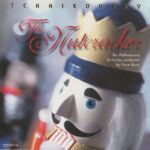
Yes, so this is a CD reissue of an album from 1958. I was thrown off by the cover because it looks very 1990s. It shows a close-up photograph of a nutcracker. Tchaikovsky’s name appears at the top and the words “The Nutcracker” appear below in flamboyant red script. The main image and the title are superimposed over a background that is purposely out of focus and is primarily light blue. The original cover was nothing ornate either. It showed an inset picture of a ballet group on stage. The album title appeared in alternating colors above the photo, and the conductor’s name below. Nothing festive or ornate, but I do like the original cover better.
While looking up the history of this CD, I discovered it was released on CD for the first time in 1989. On the back of this CD, in the copywrite notices, it reads, “This compilation published 1989”. That was another thing that led me to believe this was from the 1990s. It turns out that this version I have is really a re-release of that CD from 1989, which in itself, is a reissue of the 1958 album. All the song titles add up; there are 7 songs on all three, the titles are the same, albeit some releases have the titles in Italian or French, depending on the country of release. All signs point to this being a reissue of that 1958 album.
Tchaikovsky’s The Nutcracker is one of those niche Christmas genres that I like to collect. Currently, I have 10 CD sets dedicated to Tchaikovsky’s The Nutcracker, and all are two CD sets. It takes two CDs to hold the entire performance. I also have 20 CDs of Tchaikovsky’s The Nutcracker Suite. A list of my Tchaikovsky : The Nutcracker CDs can be found under the Lists heading above. Some of the ones I have go back to the 1940s and were originally released on 78 rpm discs. Others are on LP but most are on CD.
Pytor Ivor Tchaikovsky was commissioned to write the ballet in 1892. This was two years after he wrote the critically acclaimed ballet The Sleeping Beauty. The ballet is based on the short story The Nutcracker and the Mouse King by E. T.A. Hoffmann in 1816. After the completion of The Nutcracker, Tchaikovsky was not totally pleased with his work, at least not as much as he was with The Sleeping Beauty. The ballet takes place in a child’s mind at Christmas time. The toys and seasonal decorations come to life and dance their way into the hearts of children of all ages.
Throughout the many productions of The Nutcracker, since the first one, different ballet directors would sometimes use children in the performance. Some would use many, some would use few, if any, relying on the talents of older dancers.
Another interesting tidbit about Tchaikovsky’s The Nutcracker is that after writing the score for The Nutcracker, Tchaikovsky took 8 of the songs and formed them into a medley that has become well known as The Nutcracker Suite, Op. 71a. Oddly, the suite, which premiered nine months before the ballet, and was critically more well liked than the ballet itself, became very popular, and still is today. More often, an orchestra leader will opt to perform the suite, rather than the whole ballet in their Christmas presentations.
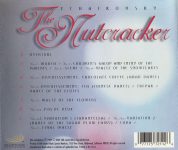
The back of the CD is also rather plain. The author and the CD title appear at the top, as they do on the front. A numerical track listing, including all the movements within the tracks, is listed. It is all presented against an out of focus picture of colored lights similar to the front cover.
Unfortunately, the back of the CD cover is completely blank. This would have been a great opportunity to put in a detailed history of the writing of the ballet, or the recording of the album. It would remove all doubt as to the origins of this music.
Everyone is familiar with some parts of The Nutcracker, and many people have their favorites. I’m no expert on Tchaikovsky’s : The Nutcracker but looking over the movements on the Wikipedia page and the movements on the back of the CD, it appears that some movements may be missing. I assure you, all the most important movements are here, and only those immensely familiar with the complete ballet, would know the difference. In my other belief, I’ve always been under the impression that the complete ballet runs longer than 76 minutes, thereby requiring 2 CDs to include the complete ballet. The total time for this CD is 48 minutes. I don’t think the entire ballet in all it’s completeness, is included here. It may not be necessary to say, but this is a studio recording and not a recording of a live performance.
After the Overture, which is very familiar, a sixteen-minute movement begins. It opens with the first dance, simply titled, March. Trust me, you know the song. What follows are less familiar passages until the next set of dances begins. Like I said, it’s over 16 minutes and the arrangement changes as each dance changes. Children’s Galop And Entry Of The Parents / Scene/ Waltz Of The Snowflakes makes up the rest of the 2nd track.
The 3rd and 4th songs are also less common Nutcracker movements; Divertissement / Chocolate Coffee (Arab Dance) and Divertissement / Tea (Chinese Dance) / Trepak / Dance Of The Flutes, respectively. Trepak should be a familiar title, and if you’re still stumped, you will know it as soon as you hear it. It is the fast-paced marching song that begins with the brass declarations while the strings provide the answers. This pattern is repeated over and over and is used as a very common way of showing off the diverse talents of an orchestra. Only Dance Of The Sugar Plum Fairy is recorded more than Trepak. Dance Of The Flutes is also very common.
Now, everybody has their favorite Nutcracker passages. I think most people favor Waltz Of The Flowers. After a wonderful introduction on the harp, the brass and woodwinds come in for the soft lead into the strings’ melody. If you think, ‘water ballet’ this is the song that you would relate to that type of performance. At almost 6 ½ minutes, it is the third longest piece on here. It is a fan favorite and there is no shortage of enjoyment.
Pas De Deux follows. It is more of a segway song, and not one that is highlighted on Christmas compilations. It is used in the story as a transition piece between Waltz Of The Flowers and Dance Of The Sugar Plum Fairy, the other most popular movement from The Nutcracker. After a soft beginning with the harp, the brass section picks up the movement and the strings join in for a triumphant blast of symphonic discourse.
The final song, or passage, on the CD is Variation 1 (Tarantella) / Variation 2 (Dance Of The Sugar Plum Fairy) / Coda / Final Waltz. Dance Of The Sugar Plum Fairy is probably the most recorded passage from The Nutcracker and appears on many Christmas compilation CDs, symphonic or otherwise.
Pytor Ivor Tchaikovsky was keen on using the celesta, the bell-like keyboard that was invented just a few years prior to the writing of the ballet. No where in any Christmas song is the celesta more at home than on Dance Of The Sugar Plum Fairy.
This CD presents Tchaikovsky’s The Nutcracker in an almost complete form, from beginning to end. This does not have to remain on the shelf throughout the year, although it is almost always heard only at Christmas time. Efrem Kurtz is one of the earliest Russian orchestra directors and does a terrific job conducting the Philharmonia Orchestra.
You don’t need a bunch of The Nutcracker CDs in your collection, but it is nice to have at least one. There are many great ones out there. The Royal Concertgebouw Orchestra, The Royal Philharmonic Orchestra and Leonard Bernstein all have CDs of The Nutcracker. When you put great conductors with great orchestras, the end results are going to be very similar. If you are looking to add one of these CDs to your collection, I can highly recommend this one by Efrem Kurtz and the Philharmonia Orchestra from 1958.
I give this CD :
*****