
October 26, 2022
# 43
Hank Snow
Snow On Christmas
2007
(P) 2007 & © 2007 Bear Family Records Made In Germany
Original RCA Victor Aufnahmen
licensed from Sony/BMG Music Entertainment (Germany) GmbH
e-mail: bear@bear-family.de internet: wwwbear-family.de
Genre : Classic Country
Hank Snow was a Canadian Country singer who started releasing records back in the 1930s. He was born Clarence Eugene Snow in Nova Scotia in 1914 and grew up poor. His mother would play piano and sing around the house. His parents divorced when he was eight and he went to live with his grandmother. Eventually he returned to his mother.
By the age of 12, he had dropped out of school and was working on fishing boats but gave that up at age 16 after experiencing near death in a violent storm. He bought himself a guitar and played and performed anywhere he could for anyone who would listen.
He joined a local radio station in Nova Scotia and performed a weekly show on Saturday nights. He changed his name to Hank and auditioned for RCA Victor in Canada. He received a recording contract and released his first record in 1936. He had a radio show on Canadian national radio and toured the country.
Hank Snow stayed with RCA Victor and moved to Nashville, Tennessee in 1949. His first record out of Nashville was a Top Ten hit and after joining the Grand Ole Opry, he became a national star. Hank Snow had many hits on the Billboard Country Singles and Albums charts. He became a naturalized citizen in America in 1958, and still maintained Canadian citizenship.
Hank Snow is a Country singer but has a lot of Western Swing roots and could be called a cowboy singer. Even starting off, he billed himself as Hank Snow, The Singing Ranger.
The Christmas CD I am reviewing today, Snow On Christmas, contains all of Hank Snow’s Christmas output, starting with a single released in 1953. Most of the CD is Hank’s first full Christmas album, Christmas With Hank Snow, released in 1966 and charted on Billboards Christmas chart in 1967. I like it when these compilation CDs contain an artist’s complete works. There are 21 songs on here and that is a lot for Christmas compilation CDs.
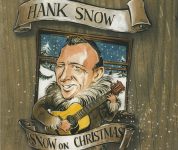
This compilation comes from Bear Family Records, a German based label that specializes in reissues of older Country, Blues, Rock and Pop albums. The cover of the CD features a caricature of Hank Snow standing in front of a cabin window playing a guitar, dressed in a suede coat with fur trim against a snowy background.
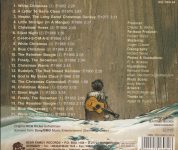
This CD is not in a regular plastic jewel case, rather it is a cardboard case that contains the CD and a 27-page booklet. The back of the CD has a caricature of Hank from behind while sitting on the snow. He is drawn much smaller than as found on the front, and he has his guitar slung around his back, but you only see the back of him. A numerical track listing including recording years and time signatures is superimposed over the artwork. To the right of all this is original and reissue production credits.
Because it is a cardboard case, there is no cover to open. The CD case opens to reveal a 27-page booklet that contains all the information I could possibly want. Inside, the CD is secured in a tray on the left side.
The front of the booklet begins to the right and contains the same drawing as found on the back of the booklet, but larger. The booklet contains a couple of color pictures of Hank in winter scenes. One is in front of his house, and the other, he is standing in front of his tour bus.
The first page with text is an endorsement of the qualities of this compilation release. Most of the book is made up of lyrics to all the songs. The songs and lyrics are listed in numerical order.
Towards the end of the booklet, 4 pages are dedicated to what is called The Christmas Song Discography. What follows is a detailed list of all the Christmas recording sessions Hank Snow did in chronological order. There is a lot of information, and it contains things such as dates, recording locations, original catalog release numbers, songs, writers and the musicians on the recording sessions, if that was available.
The last two pages is a short list of some of Hank Snow’s larger CD compilation box sets. Also, there is an address for the Hank Snow Country Music Centre in his hometown in Nova Scotia. The last page of the booklet continues the list and at the bottom is a list of newsletters you can subscribe to to keep up to date with news in Country music. (This CD having been released in 2007, most of the newsletters are probably no longer in publication).
This CD contains the best amount of information I’ve seen. I have other Christmas compilation CDs that are just as detailed, but it is a rarity.
Beware, Hank Snow IS Country! He may be from Novia Scotia, but his drawl is from the Deep South. Early in his career, Hank Snow always wanted to emulate his hero, Jimmie Rodgers, the Country pioneer. He sang like Jimmie Rodgers; he played guitar like Jimmie Rodgers, and he even named his son Jimmie Rodgers Snow.
Because this CD contains all of Hank Snow’s Christmas output, there are duplicate song titles on here. Because that doesn’t happen often with Christmas CDs, I thought it would be fun to compare the different versions of the duplicates.
The 1st song on the CD is one of those duplicate songs, White Christmas. The first one we come to, White Christmas (2), is from 1962, and the 8th song, White Christmas (3) is from Hank Snow’s 1966 Christmas album. The last song on the CD, track 21, is also White Christmas (1), recorded in 1953. On the 1953 version, Hank is billed as Hank Snow The Singing Ranger. It has a Western Swing feel to it. Pedal steel guitar, eloquent electric guitar, fiddle and brushed snare differentiate this from the later ones. The versions from 1962 and 1966 were both recorded at RCA Nashville with Chet Atkins producing. Both feature some of the same musicians and both have close to the same arrangement. The choruses sound similar but feature different members. Hank Snow’s vocals are not that different between versions, but White Christmas (1) from 1953 features a slower tempo.
The next song that is repeated is Christmas Roses, an unfamiliar song and possibly written in 1953 for Hank Snow’s single. The 5th song is the version from 1966, and the 16th song is a version from 1953. Here again, it has a Western Swing feel. The 1953 version opens with organ and steel guitar in unison and shared leads throughout the song. There is a wonderful fiddle solo in the middle. The Christmas Roses from 1966 is more polished and acoustic guitar and piano share the melody. There is a nice acoustic guitar solo in the middle, where the fiddle solo is in the 1953 version. Hank’s voice once again is virtually unchanged.
The next duplicate song is Silent Night. The 6th song is from 1966, and the 17th song is a version from 1953. Both open with an organ while the 1953 version sounds like a church organ and the 1966 version’s organ is more like a Hammond organ. The version from 1966 has the organ matched with a celeste. Both versions feature a spoken passage after the middle of the song passes.
Blue Christmas comes next. The version from 1953 opens with steel guitar and is matched with acoustic guitar and fiddle throughout the song. There is a fiddle solo in the middle of the song. The 1966 version opens with a staccato guitar for the first four bars and the celeste takes the next four before coming together during the song. The 1966 version features a strong chorus while the 1953 version does not. In fact, as the liner notes indicate, no chorus is present on any of the recordings from 1953.
Another song that appears twice is an original from Hank Snow’s Christmas single in 1953, The Reindeer Boogie. It is a Rockabilly song. The 1953 version, which is the 19th song, uses sleigh bells to start the song, after that, it is pretty much a fiddle song. Boogie guitar finishes the song while the bells return as well. In 1966, the song opens with dual guitars and towards the end features boogie woogie piano.
Frosty The Snowman is the last of the songs that have appeared twice. The 1966 version features piano as the main instrument while the guitars provide accompaniment. In the 1953 version, acoustic guitar and fiddle introduce the song and it is once again, primarily a fiddle song. The middle part features a fiddle solo with sleigh bell accompaniment. I think the 1953 version of Frosty The Snowman may be one of the best songs on here.
There are other great songs on this CD that are worthy of a mention. The 12th song is Christmas Wants, a spoken word song accompanied by soft organ from the 1966 album.
The last two songs on the original album are God Is My Santa Claus and The Christmas Cannonball. God Is My Santa Claus tells the story of how a child responds to his teacher when given the assignment to write a letter to Santa Claus. His response is that he does not have to write Santa letters, he just needs to kneel and pray. It is one of the more unusual Christmas songs I’ve ever heard, and it certainly is worthy of a listen.
The Christmas Cannonball, the last song on the original album, tells the story of the train that comes to town from the North Pole with Santa Claus aboard. The train is called The Christmas Cannonball and the song is an obvious homage to all the “cannonball” songs that were popular in Country music. I assume these two songs were written for his album. They do not show up on any other Christmas CDs I have, so that would be my first clue.
Two other unique songs come early on the CD. The 2nd song is A Letter To Santa Claus from a single released in 1974. It’s a wish list from someone who has fallen into bad times and asks Santa for love to fill his empty heart. It features a wonderful fiddle solo followed by a vocal recitation before returning to the melody. It is a terrific Christmas song.
The 3rd song tells the story of Nestor The Long Eared Donkey. Nestor was a donkey that all the animals made fun of because his ears dragged on the ground. As the story progresses, we find out that Nestor was the donkey that traveled Mary & Joseph to the manger to give birth to the baby Jesus. It was written in 1975, by Gene Autry, and was made into a TV special in 1977. I don’t know if the song was written for Hank Snow or if anybody had recorded it before Hank Snow since this is the only version I have in my collection.
Okay. Whew. I’ve written about a lot of songs, and I didn’t even cover all the songs on this large Christmas compilation CD. 21 songs are a good number, when most compilations have twelve to fourteen.
As I stated in the beginning, Hank Snow IS Country, and his heavy drawl may turn some people off. The songs are great with many original tunes. The instrumentation on the songs from the 1966 album is good, thanks to Chet Atkins. The songs from 1953, billed as Hank Snow And His Rainbow Ranch Boys, are Western Swing. Lead guitar, fiddle, steel guitar and organ give a different but pleasant sound.
This CD is not going to appeal to a lot of people. First, Hank Snow’s Country drawl. Second, it’s old Christmas music. Many of the Christmas songs from the 1950s and 1960s are timeless, they never sound dated. These are Old Country songs, and you must like Old Country to really appreciate them.
Nonetheless, it is great to have this in my collection. It contains all of Hank Snow’s Christmas output on one CD. It’s from 1953 & 1966 (mostly). It is a little on the unusual side of Christmas CDs. And the CD liner notes are fantastic, so it fits all my requirements for a great CD.
I give this CD :
****