
January 7, 2023
# 95
Morton Gould
A Musical Christmas Tree
1988
(Originally released 1969 on RCA Red Seal)
TMK(S) ® Registered * Marca(s) Registrada(s) RCA Corporation, except BMG Classics and Gold Seal logos TMs BMG Music © 1988, BMG Music
Genre : Symphonic
Morton Gould is one of the most awarded composers in modern music history. Already a child prodigy by the age of six, Morton Gould became a prolific composer, conductor, arranger and producer.
Morton Gould was born in Queens, New York City, in 1913. While staying in the New York area throughout his early life, Morton Gould played piano in movie houses, in vaudeville and on the radio. It was his numerous appearances on radio that really moved his career forward at a fast pace. At the early age of 19, Morton Gould was hired as the staff pianist for Radio City Music Hall in New York when it first opened in 1932.
Morton Gould led orchestras and composed music for radio, Hollywood films and television and was commissioned for musical scores from all around the world. It was incredible to read about all the awards he was given throughout his lifetime. Way too many to list here. I encourage you to read his page on Wikipedia to get a full grasp of this man’s accomplishments. Morton Gould – Wikipedia
The CD presented here is a reissue of his only Christmas album, recorded in 1969. The title remains the same, but any resemblance to the original album ends there. The original album featured 10 Symphonic Christmas songs performed by two separate orchestras; Morton Gould conducting the New Philharmonia Orchestra and Morton Gould conducting the RCA Symphony Orchestra. The reissue contains 6 bonus tracks.
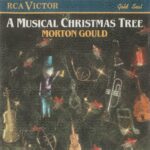
The cover of the CD features a close-up photograph of an ornately decorated Christmas tree. Many of the ornaments seen are symphonic instruments hanging on the branches. The CD title appears at the top over the photograph. The original album cover also showed a close-up of a decorated Christmas tree but purposely processed through a filter to appear distorted. Afterall, it was 1969, and even Morton Gould could appear to be hip in the counterculture. The original label name, RCA Victor Gold Seal, runs across the very top of the CD in a dark blue bar. The letters are gold.
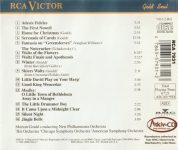
The back of the CD is rather plain, but informative. It contains a numerical track listing with time signatures. Where appropriate, writer credits are given. Upon close inspection, it is revealed that Morton Gould wrote four of the sixteen songs on the CD, two of which were on the original album. Also, where appropriate, the album the bonus tracks come from is listed. That makes it easier to put years on the bonus tracks. To the right of the track listing appears the UPC symbol and label logos, etc. As on the front cover, the same RCA Victor Gold Seal title runs across the top.
One thing included on the back cover is the letters ADD. This stands for Analog / Digital / Digital. It means the original recording was done on an analog tape machine, and the remastering was done on a digital sound mixer, and it is presented in a digital format, that being this CD. I like the ‘A’ at the beginning because that tells me that these are the original recordings (before 1985), and these are not re-recordings.
At the bottom of the back of the CD is a brief note of the performing orchestras that Morton Gould is conducting throughout the CD, including bonus tracks.
The front cover comes out and opens along a single fold-out. Almost all of both pages is taken up with the same track listing as on the back cover, including credits for the individual orchestras for each song. At the bottom of the second page is a brief proclamation of the inherent flaws possible due to the original analog recording. Apologies are made for any flaws that the digital remastering was unable to fix, but that just reinforces the fact that we are getting the original recordings. I can appreciate the producers of the reissue making this apology, but with digital technology, I would be hard pressed to hear any flaws such as tape hiss or background noise, and overall, the whole CD sounds great.
The back of the CD cover has a list of other Christmas CDs available on RCA Victor Gold Seal CDs. The background for the back of the CD cover is again a close-up of a Christmas tree, but this time there are no ornaments, just small LED lights.
We have writer credits where applicable, and when there is no writer credit given, it is presumed the song is an old traditional Christmas hymn of which no known writer exists. The songs on the CD follow the same track order as on the original album but the 6 bonus tracks fall between the 4th and the 11th songs.
There are only four songs throughout the CD that are not old familiar Christmas hymns. Three of those are original compositions, and the fourth, Jingle Bells, is the familiar Christmas carol from the 19th century. Two of the three original songs, Winter and Skiers Waltz, are ‘Winter’ songs and not necessarily Christmas songs.
Morton Gould was an incredibly talented arranger, and all the songs feature lush, symphonic arrangements. All songs are instrumental. The whole CD takes up 67:21 minutes, which is very good for a Christmas CD.
The first four songs on the CD were also the first four songs on the original album and all are performed by Morton Gould and the New Philharmonia Orchestra. Adeste Fideles and The First Nowell feature traditional, grandiose, symphonic arrangements. The 3rd and 4th songs, Home For Christmas and Serenade Of Carols are both original compositions. Home For Christmas features a haunting melody for the introduction before becoming a festive triumphant arrangement of brass and reeds.
Serenade Of Carols is more somber. Touches of familiar carols are arranged together into a medley with symphonic instruments. The arrangement builds slowly into a large ensemble that continues the familiar sounds of carols we all know. This is a treat at over 13 ½ minutes.
The next 6 songs are where all the bonus tracks lie. They are placed in the middle of the CD and divide the two original orchestras present on the album. If you removed all the bonus tracks, the CD would play in the same order as it was on the original album.
The first, Fantasia on “Greensleeves” is a lush arrangement of Greensleeves, also known as What Child Is This? This arrangement steers off track slightly, that’s where the ‘Fantasia’ comes in. It is a lush interpretation of this familiar Christmas hymn and features Morton Gould conducting his own orchestra, recorded in 1964.
The 6th and 7th songs are both passages from Tchaikovsky’s The Nutcracker, Waltz Of The Flowers and Waltz Finale And Apotheosis. After a triumphant introduction with brass instruments, Waltz Of The Flowers relies on a harp to lead us into the main body of the song. The harp section is incredible. The song then moves into the familiar melody we are all familiar with. Lush strings, flutes and reeds move this most common passage from The Nutcracker forward. It is the best song on the CD, albeit it was not on the original album. At almost 6 ½ minutes, it is one of the longest songs on here. Also, it is the only instance of this song in my Top 500 Classic Christmas Recordings.
The second song from The Nutcracker featured on the CD, Waltz Finale And Apotheosis, is a cacophony of triumphant symphonic instruments. The whole orchestra is featured throughout the song, no one is left out. Both Nutcracker pieces feature Morton Gould & The Chicago Symphony Orchestra from 1966.
The 8th song, Winter, is an original composition that features an introduction of a soft arrangement that evokes visions of a light snowfall. Less strings and more reeds keep the mood solemn. This song features Morton Gould conducting the American Symphony Orchestra, and the only time they appear on the CD. This recording was made in 1984, and it is the most recent Christmas song on the CD.
The 9th song, another original, is Skiers Waltz and again features Morton Gould conducting his own orchestra. This is the oldest recording on the CD and was recorded in 1955. The song features a heavily layered arrangement of screaming strings and brass instruments that cascade up and down the scales evoking images of skiers going down the slopes kicking up dry powder as they fly by.
Little David Play On Your Harp features a somber arrangement of strings, brass and percussion. I’m not familiar with the song, and this is the only instance of it I have in my collection although I know it has been recorded by other artists. It is a haunting arrangement that uses specific orchestral sections to tell the story of David and Goliath. This comes from a Morton Gould album recorded in 1963.
The rest of the CD finishes out the original album. The last 6 songs all feature Morton Gould conducting the RCA Symphony Orchestra, and because they were on the original album, they are all from 1969.
The arrangement for Good King Wenceslas takes a little different approach to this song than is mostly heard. Piano, harp and pizzicato strings define the arrangement.
By all accounts, the only medley on the album, O Little Town Of Bethlehem / Away In A Manger, features a traditional symphonic arrangement.
As expected, The Little Drummer Boy begins with the percussive introduction heard in many arrangements. It is not long before the rest of the RCA Symphony Orchestra joins in. That in itself is a little different. Most often, the song remains somber and subdued. Here Morton Gould uses the whole orchestra to convey the familiar melody.
It Came Upon A Midnight Clear and Silent Night both rely on traditional arrangements. While both songs are familiar, Silent Night possesses more brass in the arrangement than is typically heard.
The original album, and the CD, finishes with the only secular Christmas song, Jingle Bells. While starting with a lush arrangement of strings and reed instruments, the song relies on the brass section to deliver the melody we are most familiar with. Again, pizzicato strings add to the festivities while sleigh bells and cracking whips add texture. This is one of the most symphonic arrangements of this song I can recall.
This is an all instrumental, Symphonic CD of mostly familiar Christmas songs. Many of the arrangements are big, and in some ways, much bigger than expected. Morton Gould shows his talents extremely well with this album. If you enjoy Symphonic Christmas songs, you probably already have some Arthur Fiedler, Andre Kostelanetz and maybe some Andre Previn in your collection. You may not be as familiar with Morton Gould as you are with the others, but I assure you, you would like this just as much.
With that being said, many people would not like this CD. If you are the type that likes to sing along with your favorite Christmas songs, then you will not get that satisfaction with this CD. This Christmas CD is best left for those that do like Symphonic Christmas music. I find a place for all my Christmas music somewhere and this is best spread out over a larger playlist of more familiar arrangements.
Morton Gould is not a very well-known conductor and arranger, but he produced a terrific Christmas album in 1969.
I give this CD :
****