
November 28, 2022
# 68
VA - A Christmas Gift For You From Phil Spector
1989
(Originally released 1963 on Philles Records)
(P) 1963 and © 1989 Phil Spector Records, Inc.
Manufactured by abkco Records
# 13 – 1963 – Billboard Christmas
Genre : Soul
Gosh, where to begin? Phil Spector. Song Writer. Producer. Genius. Mad Man. Convicted Killer. For the purpose of this review, we will concern ourselves with the first three descriptions and let the other two go. (They weren’t an issue at the time of this album’s release anyway). And this CD reissue of a fantastic Christmas album from 1963 doesn’t even feature Phil Spector, it features the groups he produced. But because all the groups Phil Spector produced were “Phil Spector”, he gets his name on the album.
Phil Spector was born in the Bronx, New York, New York in 1939. He moved to Los Angeles as a teenager and eventually found himself in local bands. His first song writing attempt yielded him a # 1 hit, the song To Know Him Is To Love Him by The Teddy Bears in 1958. He worked with Lieber & Stoller as a session musician and learned about song production from them. At the age of 21, he started his own record label, Philles Records.
Phil Spector invented “the wall of sound”, and he will be forever immortalized because of it. Phil Spector’s production values were in the instruments themselves. Lots of instruments. He was known to use 5 guitars, 2 or 3 basses, 2 drum sets, 3 or 4 pianos, and whatever else he could cram into the studio, all on the same song. Because of the small space, the sound would bounce around the room, going into and out of everyone’s microphones and yielding what could only be described as a “wall” of sound.
Phil Spector used this technique to his advantage. He caught on to the Girl-Group fad at the time and he became known as the king of the Girl-Groups. During his career, he produced records for almost everyone in the music industry. In addition to the artists on this CD, Bob B. Soxx And The Blue Jeans, Darlene Love, The Crystals and The Ronettes, (Ronnie Bennett, of the Ronettes, would become Phil Spector’s wife), he produced albums for The Righteous Brothers, Ike & Tina Turner and even The Beatles and Ramones.
Everything Phil Spector had to offer the world is contained on this CD. This was a big hit when it first came out in 1963, and it has stayed a top selling Christmas album even to today. Five of the thirteen songs on here are still played on the radio every year at Christmas time.
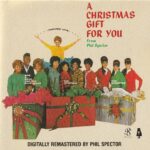
The folks at Phil Spector Records and ABKCO did a great job of duplicating the original album artwork. The CD cover is an exact duplicate…almost. The original album cover, and the CD, feature the artists standing in a row. All the women are dressed in red or green sweaters. The only man, Bob B. Soxx (Bobby Sheen), is dressed casually with a blue sweater. Darlene Love stands behind the group in a yellow outfit. Large festive Christmas gifts are in front of the group ensemble. The album title appears in red letters at the top right corner. On the album, below the title, it says “From Philles Records” and on the CD it instead says, “From Phil Spector”. The original album listed the songs in the bottom right corner, which are missing from the CD. (?) Some of the record label logos have moved around, but they’re still there.
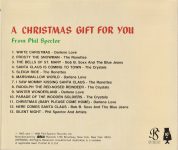
The back of the CD does not resemble the back of the album in any way. The back of the CD has the CD title in the same fonts and same colors as on the front. Below is a numerical track listing with featured performers.
The good stuff is inside. The CD cover comes out and opens up, and opens up again to form a 9 ½ “ x 9 ½ “ poster of Phil Spector dressed in a Santa suit. Once folded back up, the other pages do feature the artwork from the back of the original album. On the left side, four pictures of Phil Spector with each group are arranged evenly. These were also featured on the back of the album.
On the other page there is the same personal message from Phil Spector as on the back of the album, albeit in a different font and layout. But the entire message is included.
Once completely folded back up, the back of the front cover features a more detailed numerical track listing than what was featured on the back of the album. In addition to performing artists, song writer and publishing credits are included. Also, time signatures are provided for all the songs. Below the list of song titles, producer and engineer credits are displayed on the left, and the musicians that play on the record are listed on the right. These were also included on the back of the original album, albeit in a more festive font. But I applaud Phil Spector and ABKCO for including it. It was unusual to see something like that for an album like this back in 1963, and it’s a treat to get it on the CD in 1989.
Now, on to the CD itself. You are going to think you are hearing the same song over and over again. All the songs feature the same production qualities. Or should I say over-production qualities. That was Phil Spector’s way. It’s hard to tell The Crystals from The Ronettes from Darlene Love. Even Bob B. Soxx And The Blue Jeans sounds like the others. Nonetheless, at least five of the songs on here have become Holiday mainstays.
There are 13 songs featured and at least 10 should be very familiar and 2 others, The Bells Of St. Mary and Parade Of The Wooden Soldiers, are commonly found on Christmas releases. There’s one original Christmas song, Christmas (Baby Please Come Home) and it has probably become the most played during the holidays of any of the songs on this CD. Only one song of the 13, Silent Night, is a Christmas hymn. All the others are secular Christmas songs, most from the 20th century.
These are not traditional Christmas songs in the sense that the arrangements are lush string orchestras with flutes, trumpets and harpsichords. All the music is performed by the best studio musicians Los Angeles had to offer in the 1960s. They were colloquially called “The Wrecking Crew” and featured many artists that went on to great careers in music themselves. Leon Russell, Glen Campbell, Hal Blaine and Bobby Tedesco are just a few.
There is a string orchestra provided by Johnny Vidor, but for the life of me, it is hard to pick out amongst the guitars, basses, pianos, drums, etc.
The standout songs on here are the same ones heard on the radio every year.
The first one, the 2nd song, is The Ronettes singing Frosty The Snowman. Ronnie Bennett sounds like a 10-year-old girl. She always did. That’s just the way her voice was. Because of her youthful sounding voice, she does a great job with the vocals. The other Ronettes are heard more at the end of the song as they harmonize the title over and over as the song fades out.
Another standout song is The Crystals singing Santa Claus Is Coming To Town. There is a wonderful verse spoken at the beginning that I’ve not heard in any other version of this song. It makes this song unique. In addition to ALL the instruments going at it, there is a rocking saxophone solo during the middle break. This song should be very familiar to anyone who listens to the radio during the Christmas holidays.
The 5th song, Sleigh Ride, by The Ronettes, is another that should be very familiar to Holiday listeners. What really makes this song so great is the Ronettes’ harmonization. While Ronnie Bennett sings the vocals, the Ronettes broadcast “ring-ring-a-ling-ling-a-ling” over and over. And wait, is that violins I hear? Yes, it is. Somehow over all the other instruments, a string orchestra can be heard during the middle instrumental part.
The Ronettes’ I Saw Mommy Kissing Santa Claus features the traditional vocals heard over a wall of strings, saxophones, drums and pianos. This song also features a unique introduction of reeds, organs and strings before the sound of walking steps, kissing and a door closing is heard, then Ronnie Bennett begins her vocals.
The 9th song, Winter Wonderland, has become a Christmas classic and an annual treat every Christmas season. Darlene Love declares the vocals with conviction. She is joined by a group of girl singers, probably The Crystals, but it could be The Ronettes. Whomever they are, they do a great job of supporting Darlene Love.
Darlene Love once again entertains us with Christmas (Baby Please Come Home). If this song sounds familiar, and it should, it is because of this version. Few other artists recorded it, and this is the quintessential version. It is a raucous arrangement of pianos, saxophones and everything else Phil Spector had in the box. Once again, Darlene Love is assisted with a chorus of girl singers.
I did not mention any songs by Bob B. Soxx And The Blue Jeans only because they’re not ones that many listeners will be familiar with. Bob B. Soxx And The Blue Jeans have two songs, The Bells Of St. Mary and Here Comes Santa Claus. With no disrespect intended, they sound like the other songs, except this time there is a male vocal in the mix. The arrangements are traditional and feature the Spector “wall of sound” just like the other recordings.
The last “song” on the CD is Silent Night, the only traditional Christmas hymn. It is attributed to Phil Spector And Artists. It is a personal thank you from Phil Spector to all the people, musicians and singers that perform. Phil Spector delivers the tribute in spoken word over the melody of Silent Night. The words to Silent Night are not heard until near the end, after Phil has finished, and are delivered solemnly by a large chorus, perhaps all the singers (?)
If you like some of the songs, you will probably like most of the songs. If you don’t like some of the songs, you probably won’t like any of the songs. I have cataloged this as Soul, but this is really a Rock & Roll record. The arrangements all rock. And the primary instruments heard are traditional Rock instruments, and a lot of them. There are strings heard, but still, the overall feel is one of Rock & Roll.
As I said, five of the songs are in my Top 500 Classic Christmas Recordings because they are played every year on the radio and most people grow up hearing them whether they can consciencely recall them or not. These are not Bing Crosby, Perry Como or Judy Garland, but nonetheless, they are Classic Christmas songs.
If you’re entertaining a family gathering, one or two songs in a large playlist will be tolerable, but I wouldn’t recommend playing this straight through unless the group is looking for upbeat, rocking Christmas music. I Saw Mommy Kissing Santa Claus and Christmas (Baby Please Come Home) would be fine while decorating the Christmas tree, but I would not attempt to play any of these during Christmas dinner.
On the other hand, if you’re having a Christmas party with friends and peers, you would probably want to have this one on hand. It keeps the mood festive and upbeat. Just make sure you have plenty of room for dancing.
This CD has become a Classic Christmas album ever since it was released in 1963 and it should be in everyone’s collection. As I said, pick a few out, put them in your Christmas music playlist and when they come on, enjoy them and sing along.
I give this CD :
****