
December 6, 2022
# 75
VA - Best Of Big Bands - Christmas On The Bandstand
1994

© 1994 Sony Music Entertainment Inc./(P) 1994 Sony Music Entertainment Inc./ Manufactured by Columbia Records/ “Columbia,” “Legacy” Reg. U.S. Pat. & Tm. Off. Marca Registrada.
Genre : Big Band
This is a compilation CD of Big Band Christmas music recorded between the years 1939 and 1951. There is one song, Duke Ellington & his Orchestra performing Jingle Bells, but it is an alternate take, and I am having trouble finding a year for it, but it sounds like late 40s to mid-50s. This CD is released by Sony Music Entertainment Inc. and Columbia “Legacy” Records.
The CD cover has a picture of Benny Goodman & his Orchestra, all twelve of them, and his girl singer. And I should know who she is, but I’m a little rusty on my Big Band knowledge, and without knowing for sure when this photo was taken, I would hate to be wrong. The photo looks like it was taken in the mid to late 1930’s. They are featured on an elaborate band stand, and appear to be in mid song, but that could just be part of the publicity photograph. The CD title appears at the top of the CD in a green and red bar. The words “On The Bandstand” appears in a small white banner.
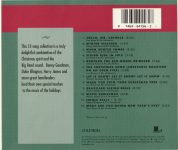
The back of the CD features a numerical track listing with time signatures. Below each song title are performing artist credits. This is all superimposed over the same green background as found on the front. Off to the side in a light green box, is an endorsement of the CD. At the top is a red bar, similar to the front, that contains the UPC code. At the bottom are the Columbia and Legacy logos as well as copywrite notices.
The CD cover comes out and because this is a Sony Music Entertainment / Columbia release, I was not expecting any new information inside. But I was wrong. The CD cover is a stapled booklet comprising 8 pages of additional information. The covers, front and back are counted as pages.
Directly inside, on the left, for some curious reason, the page is blank. The next two pages contain a detailed, numerical track listing. Along with the song titles, time signatures, band leaders, and writer credits are included. Even better, the singers are listed, and that’s important to me because that’s what I use as the artist in my database, not the band that appears on the record. I have another place for those. And still better, recording dates are provided, and some have release dates as well. This CD should get five stars on the liner notes alone.
After the track listing, two pages of reviews and endorsements (similar to what I do), of all the songs is presented.
The last page has reissue and production notices for this CD. I find this note interesting, “This recording has been processed by CEDAR®, a method of restoring sound recordings using the latest developments in digital signal processing and microcomputer technology, developed from a research program initiated by the British Sound Archive and Cambridge Sound Restoration in association with the University of Cambridge”.
“CEDAR and CEDAR Audio Ltd. are registered trademarks of CEDAR Audio Ltd. CEDAR is patented worldwide by CEDAR Audio Ltd”.
Never seen that before, but I like it very much. All these songs sound great.
The back of the CD cover is a duplicate of the back of the CD except the UPC code, and the little endorsement note are missing.
This is a Christmas CD I enjoy very much. I like Big Band music. It’s what I started collecting first, along with 1940s, 1950s and 1960s Pop Standards. There are some great, original Christmas songs here. Unfortunately, there are only 12 songs on here, but that’s not too unusual for Christmas compilation CDs. What gets me though, is the CD can hold over 75 minutes of music, yet this CD is only 35 minutes long. But I guess if they had 70 minutes of music, then the CDs would cost twice as much.
Out of the 12 songs, there are five common Christmas songs, two familiar ones and five not very familiar Christmas songs, and many of those five are unique to the bands themselves. All are secular Christmas songs, and none are traditional Christmas carols. The oldest written song is Jingle Bells, all the rest are Christmas songs from the 20th century.
The CD begins with a personal favorite Big Band Christmas song, Hello, Mr. Kringle. Kay Kyser & his Orchestra, along with his featured singers, deliver this original Christmas song from 1939. It has a “sweet” sound, not a Swing sound. The song opens with sleigh bells and features a melody of light piano, muted trumpets and reed instruments. The four singers, Harry Babbitt, Ginny Simms, Sully Mason and Ish Kabibble trade vocals as they make their requests to Santa Claus.
The 2nd song, Winter Weather, should be a familiar Christmas song to seasoned listeners. It features Benny Goodman & his Orchestra along with Peggy Lee and Art Lund sharing vocals on a real “hot” swinging Christmas song from 1941. Big Band music focused on the leader and the other musicians more than on the singers. There is usually an equal amount, or even greater amount, of instrumental passages than vocals. The song opens with blaring trumpets and other brass instruments. After Peggy Lee’s opening lyrics, Benny Goodman runs through a clarinet solo that shows off his style very well. The rest of the band fills in the middle part before Art Lund comes in for the second set of vocals. As the band continues to swing, Peggy Lee comes back for the third set of vocals. Then the band comes back without Peggy Lee and swings the arrangement until the end.
The 3rd song, When Winter Comes, recorded in 1939, is sung by Johnny MacAfee and the music is provided by Eddy Duchin & his Orchestra. As is typical of Big Band music, it is a little past the 1-minute mark of this 2 ½ minute song before the vocals begin. This song, as well as the one before, are not really Christmas songs. Rather they are “winter” songs. The 2nd song, Winter Weather, shows up on a lot of Christmas compilation CDs though.
Sleigh Ride In July is another uncommon Christmas song, perhaps because it too is a “winter” song more than a Christmas song. Les Brown & his Orchestra provide the mellow arrangement from 1944 while Gordon Drake sings the vocals. There is only one set of verses, and they describe a man who dreams of romance to the point that he takes a sleigh ride in July. (It doesn’t make much sense to me). The song finishes nicely with the celeste.
More sweet Big Band music is provided in the 5th song by Swing And Sway With Sammy Kaye, as Sammy Kaye’s band was known. Rudolph The Red-Nosed Reindeer, recorded in 1951, is the most recent song and it features a child-like arrangement sung by The Kaydets. Reed instruments, along with festive accompaniment, offer a light melody. Because it uses muted reed and brass instruments, it reminds me of Lawrence Welk’s Champagne Music. The Kaydets share the vocals in unison on the first set of verses while Nancy Norman delivers the second set of vocals by herself. After an extended musical passage, the roles are reversed. Nancy Norman picks up the vocals as The Kaydets finish the song.
The 6th song, The Christmas Song (Chestnuts Roasting On An Open Fire), again features Les Brown & his Orchestra, recorded in 1946. This very familiar Christmas classic showcases a 24 yr. old Doris Day. Doris Day was Les Brown’s girl singer since 1941. Together they had one of the biggest songs of the Big Band era, Sentimental Journey, in 1945. Doris Day is my favorite girl singer, and her approach to song lyrics is unmatched. As much here, as in most cases, she sings like she is tip-toeing on pillows. Her voice is soft and endearing. The arrangement is light and lets Doris Day’s voice sparkle.
Let It Snow! Let It Snow! Let It Snow!, the 7th song, features Woody Herman on vocals as well as orchestra leader. This familiar Christmas song was recorded in 1945. The song opens with blaring trumpets, then reeds come into play before quietening down as the vocals begin. During the instrumental breaks between verses, the band returns to swing the middle parts. (There is a terrific trumpet solo, but I don’t know who it is). Afterwards, Woody Herman returns briefly before the rest of the band swings to the finish.
Les Brown returns for the 8th song, an original Christmas song, When You Trim Your Christmas Tree, also recorded in 1946. Jack Haskell delivers the vocals. The arrangement is soft, opening with reeds, cascading strings and celeste. The vocals are soft and endearing. The song speaks of a gentleman wanting to enjoy Christmas Eve in romance with his favorite girl. This song was the B-side of the Doris Day song, The Christmas Song (Chestnuts Roasting On An Open Fire).
The 9th song, Brazilian Sleigh Bells, is performed by Harry James & his Orchestra. It is a 54 second, instrumental, fast paced trumpet song. The melody rises and falls, while the orchestra accompanies Harry James. Percy Faith wrote this in 1949, and Harry James’ version was recorded in 1950.
Song # 10, the endearing White Christmas, is from 1946 and again features Harry James & his Orchestra. Marion Morgan handles the vocals, while the orchestra lays back a bit. The song does feature a terrific trumpet solo by Harry James before the vocals begin. In all other respects, the song is traditional. Marion Morgan’s vocals are soft and endearing.
Duke Ellington & his Orchestra deliver an upbeat jazzy arrangement of Jingle Bells. I can’t find too much information on this version. Duke Ellington did record another version of Jingle Bells in 1962, but I think this pre-dates that. The CD just lists Duke Ellington & his Orchestra, but I know it’s not the one from 1962 because I have quite a few copies of that. Duke Ellington opens the song on piano, then the saxophone and trumpet trade solos back and forth. The clarinet makes a nice appearance after the middle break. It is soon joined by the saxophone and trumpet to carry the song to the end. Like I said, this is a very jazzy arrangement of the Christmas classic, and I don’t think there is another like it. I wish I knew when this was recorded!
The CD closes with one of my all-time favorite Christmas songs, What Are You Doing New Year’s Eve?, performed by Kay Kyser & his Orchestra, recorded in 1947. Again, I guess this is not really a Christmas song, but rather a New Year’s Eve song. There aren’t too many of those. Most listeners of Christmas music probably know this from Harry Connick, Jr., who did a terrific version of this song on his 1993 Christmas album. The one on this CD is the original. It too shows up on a lot of Christmas compilation CDs and may be familiar to many listeners. The arrangement is soft, mostly reed instruments and muted trumpets. Harry Babbitt delivers a soft, endearing vocal that is enhanced by the back up chorus, The Campus Kids. I make sure this plays when I’m in charge of the music. 😊
If you like Big Band music and you like Christmas music, this would be a great CD to have in your collection. I reviewed another Big Band Christmas compilation CD some time back and although they are similar, and they share three songs, this would still compliment that. This one has more of my favorites on it. There are 5 songs here that appear in my Top 500 Classic Christmas Recordings.
This is not going to appeal to most listeners because it only features a couple of familiar singers and their songs. If you, your friends or family, are looking for the familiar tunes you were raised on, you won’t find them here. That’s okay for me. These are a little older and represent a small niche in the Christmas music genre.
That and the original songs that are unique to the orchestras that perform them, is a good enough reason for me to have this in my collection.
I give this CD :
****